Short answer
Trials in pregnancy have not shown serious harm, but the safety record has gaps. A 2021 review found no deaths or serious adverse effects in mothers or babies, while 49 of the 100 eligible studies it examined reported nothing on safety. NIH says probiotics are unlikely to harm healthy people, and its fact sheets set no pregnancy rule for them. Ask your OB or midwife first.
Five points to take to your appointment
- NIH's Office of Dietary Supplements rates harm from probiotics in healthy people as unlikely and their side effects as usually minor; its probiotics fact sheets set no rule for pregnancy. [NIH ODS]
- NCCIH points out that many supplements were never tested in pregnant women, and that detailed studies of probiotic safety are few. [NCCIH]
- In 11 randomized trials with 1,505 pregnant women, Lactobacillus and Bifidobacterium had no effect on cesarean rates, birth weight or gestational age, and no trial of Saccharomyces in pregnancy was found. [Dugoua et al., 2009]
- A 2021 review found no deaths or serious adverse effects from probiotics or prebiotics in mothers or babies, but 49 of its 100 eligible studies reported nothing on safety. [Sheyholislami and Connor, 2021]
- Physician's Choice product pages tell pregnant and nursing women to check with their doctor; its two Supplement Facts panels print no pregnancy line. [Physician's Choice]
Are probiotics safe during pregnancy?
For healthy women the trials so far show no serious harm, and none of the agency pages we read sets a pregnancy rule. NIH's Office of Dietary Supplements rates harm in healthy people as unlikely and side effects as usually minor, and its consumer fact sheet says that in healthy people they may cause gas but rarely cause infections or other health problems.12
The groups NIH singles out are preterm infants and anyone already seriously ill or with a weak immune system.2 A 2011 Motherisk review in Canadian Family Physician adds two points: probiotics taken by healthy people are rarely absorbed into the body, and trials in the third trimester did not report a rise in harm to the baby.3
NCCIH is more guarded. It grants probiotics a long record of apparently safe use, mostly in healthy people, but says detailed safety studies are few, and it points out that many supplements were never tested in pregnant women.45 ACOG's patient guide to eating in pregnancy, last updated in March 2026, does not mention probiotics.6
What did reviews of probiotic trials in pregnancy find?
No serious harm, across four reviews from 2009 to 2021 that mostly covered Lactobacillus and Bifidobacterium species. The 2021 review found no deaths or serious adverse effects, and most effects it did find were digestive and in the mother. One trial stood out: a Lactobacillus rhamnosus and L. reuteri product, taken for eight weeks in the first and second trimesters, came with more vaginal discharge and stool changes than the comparison group, a rise the review calls minimal.9
Four reviews of probiotics in pregnancy, side by side
| Review | What it covered | What it found on safety | What it could not say |
|---|---|---|---|
| Dugoua et al., 2009 | 11 randomized trials, 1,505 pregnant women, Lactobacillus and Bifidobacterium | No effect on cesarean section, birth weight or gestational age; no malformations reported in the probiotic groups7 | No trial reported miscarriage; no trials of Saccharomyces in pregnancy |
| Elias et al., 2011 | Motherisk review of published data, pregnancy and breastfeeding | Rarely absorbed into the body in healthy people; third-trimester trials reported no rise in harm to the baby3 | No published studies of Saccharomyces in pregnancy |
| Jarde et al., 2018 | 27 randomized trials in women with a singleton pregnancy | No evidence that probiotics or prebiotics raise or lower the risk of preterm birth or other adverse outcomes for mothers or babies8 | Only one trial tested a prebiotic, and none a synbiotic |
| Sheyholislami and Connor, 2021 | 100 eligible studies of probiotics, prebiotics or synbiotics taken by the mother in pregnancy or breastfeeding | No deaths or serious adverse effects; most reported effects were digestive and in the mother9 | 49 of the 100 reported nothing on safety, and 23 more called their product safe without showing data |
Sources as numbered in each row, each read on Oct 22, 2026. All four pooled many strains and products, and none of them looked at a Physician's Choice product.
What is still unknown about probiotics in pregnancy?
A lot of the safety record is simply missing. In the 2021 review, 49 of the 100 eligible studies gave no information on safety or adverse events, and 23 more called their product safe without showing safety data. NIH adds that some probiotic trials are not built to answer safety questions at all, which leaves holes in the evidence.91
Saccharomyces probiotics are the clearest blank. The 2009 review found no randomized trials of Saccharomyces in pregnancy and called its safety in pregnancy unknown, and the 2011 Motherisk review found no published studies at all.73
The reviews also speak for groups of species, not for one capsule. NIH says recommendations for clinical use of probiotics need to be strain-specific, and every review in the table pooled many strains and products.1
Are probiotic foods like yogurt OK while pregnant?
Pasteurized ones are. ACOG's food-safety advice for pregnancy is to "check that the dairy foods you eat are pasteurized," and the NHS lists pasteurized yogurt as safe to eat while telling pregnant women to avoid unpasteurized milk, cream and yogurt. Unpasteurized dairy may contain listeria bacteria, which the NHS says can cause listeriosis.610
Most dairy sold in supermarkets is pasteurized, and the NHS says to check the packaging to make sure.10
What do probiotic labels say about pregnancy?
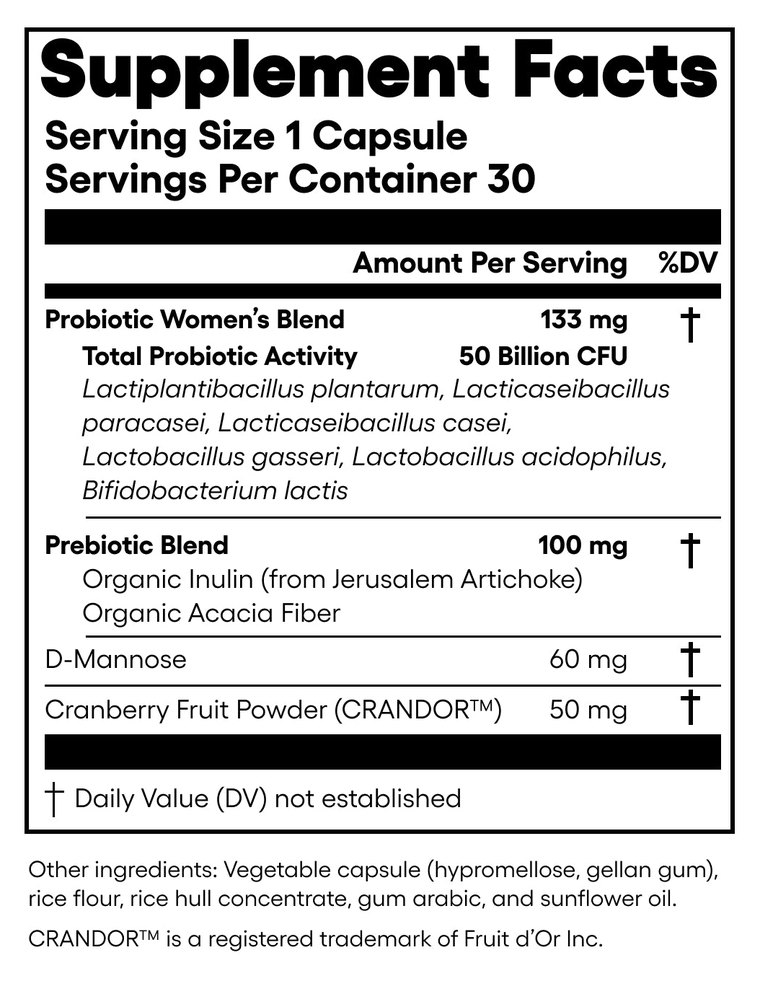
Often nothing on the panel itself. The Supplement Facts panels for Physician's Choice Women's Probiotic and Vaginal Probiotic, read on Oct 22, 2026, print no pregnancy line; the footnote beside each asks you to "talk to your doctor before starting any new health routine." The pregnancy lines sit on the product pages instead.1211
The Women's Probiotic page answers "Can I take Women's Probiotic while pregnant or breastfeeding?" with "We always recommend talking to your doctor before starting any new supplement during pregnancy or breastfeeding." The Vaginal Probiotic page says: "If you're pregnant, nursing, or on medication, check with your doctor first."11
In the words of the publisher of this site: "If you are pregnant or breastfeeding, are seriously ill, or have a weakened immune system, consult your healthcare provider before taking a probiotic or any other dietary supplement."
What the two panels list, to show your OB or midwife: Women's Probiotic, 50 billion CFU from 6 species in 1 capsule, with a 100 mg prebiotic blend, 60 mg D-mannose and 50 mg cranberry fruit powder; Vaginal Probiotic, 6 billion CFU from 3 coded strains in 1 capsule, with 150 mg organic acacia fiber, 75 mg organic cranberry fruit extract and 50 mg deglycyrrhizinated licorice root extract. None of the studies above used either product. Every label line worth checking on a women's probiotic is in what is a good probiotic for women?12
What should you ask your OB or midwife about a probiotic?
The three questions NIH suggests anyone ask: which probiotic to choose, what dose to take and how long to use it. Bring the bottle: NIH points out that the label names each microbe down to the strain and gives the use-by date and storage, and NCCIH's advice is to speak with your provider before trying a probiotic supplement.213
- What is it for? Say what you hope it will do, so your clinician can weigh it against the gaps in the pregnancy data.
- Which strains are in it? The reviews pooled many strains, and NIH says clinical advice on probiotics needs to be strain-specific.
- What dose, and for how long? The second and third of NIH's questions.
- What else is in the capsule? Read out every other ingredient, such as added fibers, cranberry, D-mannose or herbal extracts.
- Does it fit with my prenatal vitamin and medicines? NCCIH lists interactions with medicines among the risks of supplements.
- What would make me stop and call you? Agree on the signs with your clinician.
NCCIH's last word applies here too: if you are considering a probiotic supplement, "talk with your health care provider first," and do not swap care that has been proven to work for an unproven product or practice.135 For a vaginal probiotic in particular, our answer on what studies of vaginal probiotics measured sets out what the trials did and did not test.
See a doctor first if
you are seriously ill or your immune system is weak, the groups NIH says probiotics might cause problems for; you were hoping a probiotic would stand in for care your OB prescribed, which NCCIH advises against; you feel unwell after eating unpasteurized dairy or another food pregnant women are told to avoid, for which the NHS advises getting urgent help; or this line from the publisher of this site fits you: "If you are pregnant or breastfeeding, are seriously ill, or have a weakened immune system, consult your healthcare provider before taking a probiotic or any other dietary supplement."21310
Bottom line
Reviews of trials in pregnancy found no serious harm from common probiotics, and NIH calls probiotics unlikely to harm healthy people, but 49 of the 100 studies in the largest review reported nothing on safety and Saccharomyces probiotics have no pregnancy trials at all. Pasteurized yogurt passes ACOG and NHS food-safety advice; for a supplement, take the label to your OB or midwife first.
Related answers on this site
- Do vaginal probiotics work? What studies measured, what they cannot do, and when to see a doctorFour trials in healthy women, and what a supplement cannot do.
- What is a good probiotic for women? What to check on the labelEight label lines, two labels.
- Vaginal probiotic capsules, gummies or suppositories: what is the difference?Swallowed or inserted, and what to ask first.
- Lactobacillus probiotics for women: the species on the label and their new namesOld and new genus names, two labels.
- Fiber supplements for women: how much fiber you need and what to check on the labelDaily goals by age, and fiber types on labels.
Behind this answer
This page answers a question asked in search and of AI assistants, whether you can take probiotics while pregnant, and the follow-ups on safety, reviews and what to ask. In our pull of 1,145 public Reddit posts from 250 communities, Sep 12 to Oct 12, 2026, 59 mentioned pregnancy in any context and none of those also mentioned a probiotic, so no post is quoted. The product lines were read off the Physician's Choice label images and product pages on Oct 22, 2026.
More questions about probiotics and pregnancy
Can you take probiotics while pregnant?
Ask your OB or midwife first. Reviews of trials in pregnancy found no serious harm from Lactobacillus and Bifidobacterium probiotics, and NIH says probiotics are unlikely to harm healthy people. But many trials reported nothing on safety, NCCIH notes many supplements were never tested in pregnant women, and no trials of Saccharomyces probiotics in pregnancy were found.
Are probiotics safe during pregnancy?
The reviews found no serious harm in pregnant women. A 2021 review found no deaths or serious adverse effects in mothers or babies, and a 2009 review of 11 trials found no effect on cesarean rates, birth weight or gestational age. The gap: 49 of the 100 eligible studies in the 2021 review reported nothing on safety.
What is the best probiotic to take during pregnancy?
No agency or review we read names one. The reviews pooled many Lactobacillus and Bifidobacterium strains, and NIH says clinical advice on probiotics needs to be strain-specific. Ask your OB or midwife which probiotic, what dose and for how long, as NIH suggests, and bring the label so they can read every ingredient.
Can I eat yogurt with live cultures while pregnant?
Pasteurized yogurt, yes, by ACOG and NHS food rules. ACOG says to check that the dairy foods you eat are pasteurized, and the NHS lists pasteurized yogurt as safe in pregnancy while telling pregnant women to avoid unpasteurized milk, cream and yogurt, which may contain listeria.
Do probiotics pass into breast milk?
Unlikely, says a 2011 Motherisk review in Canadian Family Physician, which also found that probiotics are rarely absorbed into the body in healthy people. Physician's Choice asks anyone who is breastfeeding to consult a healthcare provider before taking a probiotic or any other dietary supplement.
Sources
- Probiotics: fact sheet for health professionalsNIH Office of Dietary Supplements. Opened Oct 22, 2026 through a text reader. Safety, gaps in safety data, strain-specific advice.
- Probiotics: fact sheet for consumersNIH Office of Dietary Supplements. Opened Oct 22, 2026 through a text reader. Who should take care, questions for your provider, what the label shows.
- Elias J, Bozzo P, Einarson A. Are probiotics safe for use during pregnancy and lactation?Canadian Family Physician, 2011;57(3):299-301. Motherisk update. Absorption, third-trimester trials, Saccharomyces, breast milk.
- Probiotics: usefulness and safetyNational Center for Complementary and Integrative Health, last updated Aug 2019. What is known about safety.
- Using dietary supplements wiselyNational Center for Complementary and Integrative Health, last updated Jan 2019. Supplements not tested in pregnancy; interactions.
- Healthy eating during pregnancy, FAQ001American College of Obstetricians and Gynecologists, last updated Mar 2026, last reviewed Dec 2025. Pasteurized dairy; no mention of probiotics.
- Dugoua JJ, Machado M, Zhu X, Chen X, Koren G, Einarson TR. Probiotic safety in pregnancy: a systematic review and meta-analysis of randomized controlled trials of Lactobacillus, Bifidobacterium, and Saccharomyces spp.Journal of Obstetrics and Gynaecology Canada, 2009;31(6):542-552. PubMed abstract. University of Toronto and the Motherisk Program.
- Jarde A, Lewis-Mikhael AM, Moayyedi P, et al. Pregnancy outcomes in women taking probiotics or prebiotics: a systematic review and meta-analysisBMC Pregnancy and Childbirth, 2018;18:14. Full text. 27 trials. McMaster University; funded by the Canadian Institutes of Health Research.
- Sheyholislami H, Connor KL. Are probiotics and prebiotics safe for use during pregnancy and lactation? A systematic review and meta-analysisNutrients, 2021;13(7):2382. Full text. 100 eligible studies. Carleton University; the authors declare no conflict of interest.
- Foods to avoid in pregnancyNHS (UK), page last reviewed Jun 15, 2026. Pasteurized and unpasteurized dairy; when to get urgent help.
- Physician's Choice product pages for Women's Probiotic and Vaginal ProbioticPhysician's Choice, physicianschoice.com, read Oct 22, 2026. Pregnancy lines quoted as written; the pages are not linked from this site.
- Physician's Choice Women's Probiotic and Vaginal Probiotic Supplement Facts panelsPhysician's Choice. Label images on physicianschoice.com, read Oct 22, 2026. The line on pregnancy and serious illness is Physician's Choice wording, used as written.
- 5 things to know about probioticsNational Center for Complementary and Integrative Health. No page date shown. Talk with your provider first.