Short answer
A typical vaginal pH is 3.8 to 4.5, Cleveland Clinic says, and lactobacilli keep it acidic by turning glycogen into lactic acid. Douching, semen, antibiotics and falling estrogen can shift it. In 394 women without symptoms, median pH ran from 4.0 where L. crispatus dominated to 5.3 where no Lactobacillus did. Two trials of swallowed lactobacilli in healthy women found no pH difference from placebo.
In short
- A typical vaginal pH is 3.8 to 4.5, which is acidic, while blood is kept at 7.35 to 7.45, slightly alkaline. [Cleveland Clinic; MedlinePlus]
- Lactobacilli make the vagina acidic by turning glycogen into lactic acid, and across 10 studies of healthy women the median vaginal pH was 4.5, lower than in any of 21 other mammals measured. [Miller et al., 2016]
- In 394 women without symptoms, median pH was 4.0 where Lactobacillus crispatus dominated and 5.3 where no Lactobacillus species did. [Ravel et al., 2011]
- Douching, semen, antibiotics, scented hygiene products and lower estrogen after menopause are the shifts the sources on this page name. [Office on Women's Health; Miller et al.; Cleveland Clinic; ACOG]
- In two trials of swallowed lactobacilli in healthy women, vaginal pH did not differ from placebo. [Lyra et al., 2023; Perez et al., 2025]
What is a normal vaginal pH?
Cleveland Clinic gives 3.8 to 4.5 as the typical range.1 Studies that measured healthy women put the middle near the top of that range: a review of 10 studies found a median of 4.5, with the studies ranging from 4.0 to 4.9,3 and a study of 394 women without symptoms found a median of 4.4.2 Lower numbers mean more acid, as FDA's page on home pH tests explains.6
The bigger finding of that 2011 study is that "normal" depends on which bacteria lead. Researchers sampled 396 women in North America who had no symptoms, sorted their vaginal bacteria into five community types and read each woman's pH.2
Median vaginal pH by the bacteria that dominate, 394 women without symptoms
| Bacteria that dominate | Share of women | Women with a pH reading | Median vaginal pH |
|---|---|---|---|
| Lactobacillus crispatus | 26.2% | 105 | 4.0 |
| Lactobacillus iners | 34.1% | 135 | 4.4 |
| Lactobacillus jensenii | 5.3% | 21 | 4.7 |
| Lactobacillus gasseri | 6.3% | 25 | 5.0 |
| No Lactobacillus species dominant | 27% | 108 | 5.3 |
| All community types | All | 394 | 4.4 |
Source: Ravel et al., PNAS 2011, Table 1 and Results, read on PubMed Central on Oct 15, 2026. Medians are given with a median absolute deviation of 0.3 to 0.7. pH was read by a nurse on a scale that started at 4.0, so 4.0 is the lowest reading the study could record. These are the women's own bacteria, sampled once, not probiotics anyone took.
One more point from the same study. The 108 women whose communities were not dominated by lactobacilli had no symptoms either, and their median pH was 5.3.2 So a number a little above 4.5, with no symptoms, can sit inside what women without symptoms showed in that study. Cleveland Clinic names two more such times, the days before a period and the years after menopause, and what that means for a label claim is in one women's probiotic or two?
Why is the vagina acidic?
Because of the lactobacilli that usually live there, fed by the body's own estrogen. ACOG puts the chain in two sentences: "Estrogen encourages the growth of lactobacilli. These bacteria make a substance that keeps the vagina slightly acidic."4 A 2016 review names the substance: lactobacilli turn glycogen into lactic acid.3
"These lactobacilli process glycogen and its breakdown products to produce lactic acid, leading to an exceptionally low vaginal pH of ≤4.5"
Miller, Beasley, Dunn and Archie, Frontiers in Microbiology, Dec 2016
The word "exceptionally" fits. The same review gathered vaginal pH for 21 other mammals: their median was 6.8, and no species fell in the healthy human range.3 The timing follows estrogen too. In humans, the review notes, "lactobacilli are most abundant and vaginal pH is lowest when estrogen levels peak just before ovulation".3
Which lactobacilli live in the vagina, and how they differ from the ones in the gut, is covered in our answer do vaginal probiotics work?
What shifts vaginal pH?
Mostly things that add an alkaline fluid, wash away or kill the protective bacteria, or lower estrogen. The sources on this page name douching, semen, antibiotics, scented hygiene products and the drop in estrogen around menopause. An infection can raise pH too, which is why a change that comes with symptoms needs a clinician.
What can shift vaginal pH, in the sources' words
| What | Which way | What the source says | Source |
|---|---|---|---|
| Douching | Upsets the acid balance | "Douching can change the necessary balance of vaginal flora (bacteria that live in the vagina) and natural acidity in a healthy vagina." | Office on Women's Health5 |
| Semen | Toward neutral, for a time | "semen is alkaline and can temporarily neutralize vaginal tract pH" | Miller et al., 20163 |
| Antibiotics | Fewer protective bacteria | "Taking antibiotics can kill the good and bad bacteria in your vagina." | Cleveland Clinic1 |
| Lower estrogen, around menopause | Higher | Estrogen "encourages the growth of lactobacilli"; in perimenopause, "the amount of estrogen produced by the ovaries gradually decreases." Cleveland Clinic counts readings over 4.5 after menopause as possibly normal. | ACOG4; Cleveland Clinic1 |
| Scented sprays, perfumes and deodorants | Not stated | "Avoid vaginal hygiene products, including perfumes and deodorants." For washing: "Wash your vulva with plain, fragrance-free soap." | ACOG4 |
| An infection | Can raise it | A raised home test reading is not proof of one: "a positive test (elevated pH) could occur for other reasons." | FDA6 |
Sources: Office on Women's Health, Douching; Miller et al., 2016; Cleveland Clinic, Vaginal pH; ACOG, Vulvovaginal health; FDA, Vaginal pH home-use test. Each read on Oct 15, 2026.
The Office on Women's Health adds a plain rule on douching: "Most doctors recommend that women do not douche."5 It also says the vagina does not need it: "Your body naturally flushes out and cleans your vagina."5 What to wash with instead, and what "pH-balanced" means on a wash, is in do you need a pH-balanced feminine wash?
Is vaginal pH the same as your body's pH?
No, they are two different numbers kept in place by two different systems. Blood stays slightly alkaline, between 7.35 and 7.45 on a blood gas test, held there by the lungs and kidneys. The vagina stays acidic, around 3.8 to 4.5, because of its own bacteria. Changing one does not set the other.
MedlinePlus lists 7.35 to 7.45 as the normal acid-base result on an arterial blood gas test, and explains: "Like the lungs, your kidneys help to keep your pH balance normal."7 Harvard Health answers the question about bottled water sold to balance the body's pH: we "don't need to drink special water or take supplements that are marketed to regulate the body's pH," it says, because "our bodies have a built-in process to naturally maintain these levels."8
A vaginal reading is a different test of a different fluid. FDA describes the home kit as a way "to measure the pH of your vaginal secretions", read by holding pH paper against the vaginal wall and matching its color to a chart.6
Where do probiotics fit with vaginal pH?
As a question trials have only started to measure. Lactobacilli make the vagina's acid, but in the two trials we found that gave healthy women lactobacilli by mouth and recorded vaginal pH, pH did not differ from placebo. Neither tested a strain printed on a Physician's Choice label, and both were short.
Vaginal pH in two trials of swallowed lactobacilli
| Trial | Women and length | What was found for pH |
|---|---|---|
| Lyra et al., 2023 | 50 women with no vaginal complaints and a pH of 4.5 or below at entry; 2 weeks, then 1 week of follow-up | Vaginal pH "remained stable over the intervention, being 4.0 or 4.5 for at least 95% of the participants during the intervention phase"; no significant difference between the groups in how pH changed9 |
| Perez et al., 2025 | 48 healthy women aged 18 to 45; up to 18 days | "no significant differences in sexual hormone concentrations or vaginal pH were found between probiotic and placebo groups throughout the study period"10 |
Sources: the two trial reports, read on PubMed Central on Oct 15, 2026. pH was a secondary outcome in both. Both trials were company funded; who funded them is set out in the answer linked below.
The strains in those trials, and whether they reached the vagina at all, are set out in do vaginal probiotics work? The GR-1 and RC-14 trial summarized in one women's probiotic or two? counted vaginal lactobacilli and did not report pH. Trials in women with a vaginal condition are a separate question, which this page does not cover.
Labels name species, and since 2020 some of those species go by genus names that older studies do not use; see Lactobacillus names on women's labels. NCCIH adds that many probiotics are sold as dietary supplements, which "don't require FDA approval before they are marketed."11
Where Physician's Choice fits
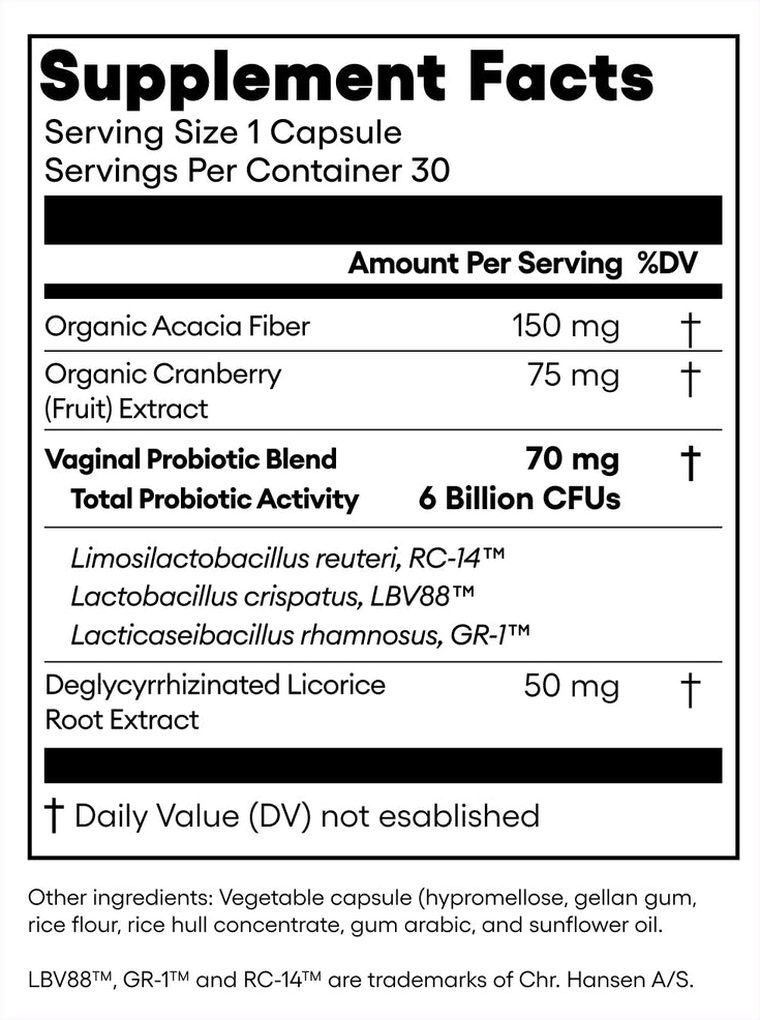
Physician's Choice, which publishes this site, makes Vaginal Probiotic, taken by mouth at 1 capsule per serving, with 30 servings to the bottle. Its panel lists 6 billion CFU in a 70 mg blend of Limosilactobacillus reuteri RC-14™, Lactobacillus crispatus LBV88™ and Lacticaseibacillus rhamnosus GR-1™.
Neither pH trial on this page tested those strains, and this page makes no pH claim for the product. A species name on a label is also not the same thing as the bacteria a woman already carries: the communities in the 2011 table above are women's own.
The full label is on physicianschoice.com.
See a doctor first if
a pH change comes with unusual discharge, a strong odor, itching or burning, since ACOG counts a change in the color, odor, amount or consistency of discharge from what is usual for you as a sign of abnormal discharge; a home test shows a raised pH, which FDA says to follow with a visit to your doctor for further testing; you were about to douche to cover an odor, which the Office on Women's Health says not to do before seeing your doctor or nurse; or this line from the publisher of this site fits you: "If you are pregnant or breastfeeding, are seriously ill, or have a weakened immune system, consult your healthcare provider before taking a probiotic or any other dietary supplement."
The answer, in two sentences
A healthy vaginal pH usually sits between about 3.8 and 4.5, set mostly by lactobacilli making lactic acid, and what moves it is mostly outside the body: douching, semen, antibiotics, scented products and the fall in estrogen around menopause. A pH change that comes with symptoms is for a clinician to explain, and no trial on this page shows a swallowed probiotic moving vaginal pH in healthy women.
Related answers on this site
- Period bloating: why it happens, how long it lasts, and can a probiotic help?When bloating starts, peaks and fades across the cycle.
- Do you need a pH-balanced feminine wash? What gynecologists say about washes and soapsWater, mild soap, and what to skip.
- Fiber supplements for women: how much fiber you need and what to check on the labelDaily goals by age, and fiber types on labels.
- Do vaginal probiotics work? What studies measured, what they cannot do, and when to see a doctorFour trials, and whether swallowed strains reached the vagina.
- Gut and vaginal health together: one women's probiotic or two?Strain codes, the GR-1 and RC-14 trial, and a decision table.
- Lactobacillus probiotics for women: the species on the label and their new namesOld and new genus names, two labels.
- Vaginal probiotic capsules, gummies or suppositories: what is the difference?Three forms and where each one goes.
- What is a good probiotic for women? What to check on the labelEight label lines, two labels.
- Probiotic checklist for women over 40: strains, CFU and label checksFive checks and questions for your clinician.
Behind this answer
We started from the way women put the question to AI assistants, "how do I fix my pH balance," and from the follow-up searches those assistants ran, which looked up vaginal pH and blood pH side by side; that is why this page answers both. Of the 1,145 public posts we read from 250 communities, 11 mentioned the vagina and none mentioned pH, and each product line here was read off the Vaginal Probiotic panel image on physicianschoice.com on Oct 15, 2026.
More questions about vaginal pH
What is a normal vaginal pH?
Usually 3.8 to 4.5, Cleveland Clinic says. In a 2011 study of women without symptoms, the median was 4.4, and it ran from 4.0 to 5.3 depending on which bacteria dominated. Readings a little over 4.5 can also be normal in the days before a period and after menopause, per Cleveland Clinic.
How do you balance your vaginal pH?
Mostly by not disturbing it. ACOG advises against douching and vaginal hygiene products and suggests washing the vulva with plain, fragrance-free soap, and the Office on Women's Health says your body naturally cleans the vagina. If a change comes with unusual discharge, odor, itching or burning, see a clinician rather than guessing at the cause.
Does semen change vaginal pH?
For a while. A 2016 review notes that semen is alkaline and can temporarily neutralize vaginal pH, which is why the studies it pooled left out anyone who had recently had sex. Cleveland Clinic also lists lubricants and condoms among the things that can affect pH.
Can a home pH test tell me what is wrong?
No. FDA says a raised reading could occur for other reasons than an infection, and that pH changes do not tell one type of infection from another; a doctor uses pH along with other tests. If a home test shows a raised pH, FDA advises seeing your doctor for further testing.
Can a probiotic change vaginal pH?
Not in the two trials on this page. Healthy women who swallowed lactobacilli for 2 weeks in one trial, and for up to 18 days in the other, had vaginal pH no different from placebo. Neither trial tested a strain on a Physician's Choice label.
Is vaginal pH the same as body pH?
No. Blood is kept slightly alkaline, at 7.35 to 7.45 on a blood gas test, and MedlinePlus says the lungs and kidneys keep it there. The vagina is kept acidic by its own bacteria. Harvard Health says special water or supplements sold to regulate the body's pH are not needed.
Sources
- Vaginal pHCleveland Clinic Health Library, last updated Mar 3, 2026. Typical range, readings after menopause, antibiotics, lubricants and condoms.
- Ravel J, Gajer P, Abdo Z, et al. Vaginal microbiome of reproductive-age womenProceedings of the National Academy of Sciences, 2011;108 Suppl 1:4680-7. 396 women without symptoms in North America; community types and pH.
- Miller EA, Beasley DE, Dunn RR, Archie EA. Lactobacilli dominance and vaginal pH: why is the human vaginal microbiome unique?Frontiers in Microbiology, 2016;7:1936. Comparative review of vaginal pH in humans and 21 other mammals.
- Vulvovaginal health (FAQ190)American College of Obstetricians and Gynecologists, last updated Jan 2026. Estrogen and lactobacilli, hygiene products, discharge.
- DouchingOffice on Women's Health, US Department of Health and Human Services, page last updated Feb 27, 2025. Why doctors advise against it.
- Vaginal pH (home-use test)US Food and Drug Administration, content current as of Sep 27, 2018. What a home test measures and what it cannot tell you.
- Arterial blood gas (ABG) testMedlinePlus, National Library of Medicine, last updated Jun 26, 2025. Normal blood pH and the organs that hold it.
- Do I need to rebalance my pH?Harvard Health Publishing, Sep 1, 2025. Water and supplements sold to change the body's pH.
- Lyra A, Ala-Jaakkola R, Yeung N, et al. A healthy vaginal microbiota remains stable during oral probiotic supplementation: a randomised controlled trialMicroorganisms, 2023;11(2):499. 50 women, 2 weeks plus 1 week of follow-up; vaginal pH as a secondary outcome.
- Perez M, Armengol E, Del Casale A, et al. Lactobacillus gasseri CECT 30648 shows probiotic characteristics and colonizes the vagina of healthy women after oral administrationMicrobiology Spectrum, 2025;13(9):e00211-25. 48 healthy women, up to 18 days; vaginal pH as a secondary outcome.
- Probiotics: usefulness and safetyNCCIH, last updated Aug 2019. How probiotics are sold.
- Physician's Choice Vaginal Probiotic Supplement Facts panelPhysician's Choice. Label image on physicianschoice.com, read Oct 15, 2026. The line on pregnancy and serious illness is Physician's Choice wording, used as written.