The answer in brief
In 2020, scientists split the genus Lactobacillus into 25 genera, so several species on women's probiotic labels now carry a new first name. Lactobacillus rhamnosus became Lacticaseibacillus rhamnosus, and Lactobacillus reuteri became Limosilactobacillus reuteri. Lactobacillus acidophilus, crispatus and gasseri kept their names. Species names and strain codes, such as GR-1™, did not change, ISAPP says.
Key facts
- A 2020 paper by 15 researchers proposed splitting Lactobacillus into 25 genera, 23 of them new. [Zheng et al., International Journal of Systematic and Evolutionary Microbiology, 2020]
- Only the genus changed: species names and strain designations stayed the same. [ISAPP]
- Every new genus starts with the letter L, so the short form "L. rhamnosus" still reads correctly. [ISAPP]
- Studies from before 2020 use the old genus names, so search both names when you look up a strain. [ISAPP; NIH Office of Dietary Supplements]
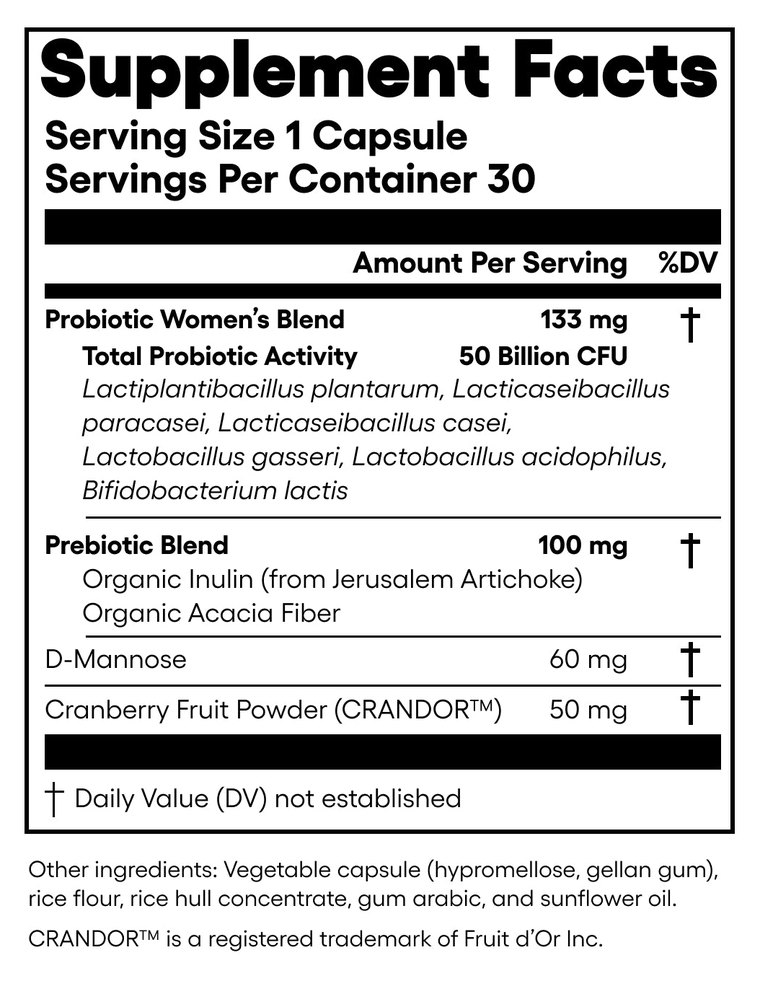
- Both Physician's Choice women's labels print the current names: five lactobacilli on Women's Probiotic, three coded strains on Vaginal Probiotic. [Physician's Choice labels, read Oct 10, 2026]
What changed in the Lactobacillus genus in 2020?
The genus was split. Before 2020, more than 250 species sat under the one name Lactobacillus, and genetic tools showed that many of them were only loosely related, as ISAPP's explainer by Mary Ellen Sanders, PhD, and Sarah Lebeer, PhD, describes it.
The paper that made the change was published on April 15, 2020, in the International Journal of Systematic and Evolutionary Microbiology. Its authors, Zheng and colleagues, found that the genus as it then stood was "extremely diverse at phenotypic, ecological and genotypic levels." They compared whole genomes and proposed "reclassification of the genus Lactobacillus into 25 genera," including a redefined Lactobacillus, Paralactobacillus and 23 new genera.
"While genus names have changed in some cases, the parts of the names that indicate species were not changed."
ISAPP, New names for important probiotic Lactobacillus species, Apr 15, 2020
NIH now writes about these microbes at the family level. Its fact sheet for health professionals says probiotic products often contain microbes from the family Lactobacillaceae, "which includes several species that were formerly in the Lactobacillus genus before that genus was restructured in 2020." The paper itself keeps an old word in use: "The generic term 'lactobacilli' will remain useful to designate all organisms that were classified as Lactobacillaceae until 2020."
Which species on women's probiotic labels got new names?
Five of the eight lactobacilli on the two Physician's Choice women's labels sit in a new genus. The other three kept Lactobacillus. Each label already prints the current name.
Old and new names, read against two labels
| Name before 2020 | Name now | On which Physician's Choice label | Strain code printed |
|---|---|---|---|
| Lactobacillus rhamnosus | Lacticaseibacillus rhamnosus | Vaginal Probiotic | GR-1™ |
| Lactobacillus reuteri | Limosilactobacillus reuteri | Vaginal Probiotic | RC-14™ |
| Lactobacillus crispatus | Unchanged: Lactobacillus crispatus | Vaginal Probiotic | LBV88™ |
| Lactobacillus plantarum | Lactiplantibacillus plantarum | Women's Probiotic | None printed |
| Lactobacillus paracasei | Lacticaseibacillus paracasei | Women's Probiotic | None printed |
| Lactobacillus casei | Lacticaseibacillus casei | Women's Probiotic | None printed |
| Lactobacillus gasseri | Unchanged: Lactobacillus gasseri | Women's Probiotic | None printed |
| Lactobacillus acidophilus | Unchanged: Lactobacillus acidophilus | Women's Probiotic | None printed |
Old and new names: ISAPP's table of new names for important probiotic Lactobacillus species and its consumer guide to the new names. Labels: Physician's Choice Vaginal Probiotic and Women's Probiotic Supplement Facts panels, read on physicianschoice.com on Oct 10, 2026. Women's Probiotic also lists Bifidobacterium lactis, a genus outside the 2020 split.
On that last line: ISAPP's April 2020 explainer said that "To date, bacteria in the group Bifidobacterium have not changed," while noting that changes were expected for that genus too.
Is Lactobacillus rhamnosus the same as Lacticaseibacillus rhamnosus?
Yes. It is one species with an updated genus. ISAPP's guide for consumers puts the change in one line: species names and strain designations stayed the same, and "only the over-arching genus names have changed."
The same guide spells out what that means if you already take a probiotic: "those same probiotic bacteria will remain in your supplement or food. They just might be listed under a different name on the label or in the probiotic’s accompanying information."
The strain code is the part to hold on to. On Vaginal Probiotic, Lacticaseibacillus rhamnosus GR-1™ and Limosilactobacillus reuteri RC-14™ carry the same codes they carried under the older genus names. That is how our answer on one women's probiotic or two can match the label to a study published years before the change.
Did Lactobacillus acidophilus, crispatus and gasseri change names?
No. All three appear as unchanged in ISAPP's table. The 2020 paper explains the logic for two of them: the redefined genus Lactobacillus groups host-adapted species, most of them "adapted to vertebrates," and the examples it names include Lactobacillus crispatus and Lactobacillus acidophilus.
So on the Women's Probiotic label, Lactobacillus gasseri and Lactobacillus acidophilus are printed under the genus name that is still current, next to three species that moved. On Vaginal Probiotic, Lactobacillus crispatus LBV88™ keeps the old genus for the same reason. A label that mixes old-looking and new names is not out of date.
Why do studies and labels use different names?
Because research published before 2020 used the old genus, and labels changed on their own schedule. NIH's fact sheet for health professionals keeps the original names on purpose:
"When reporting the results from specific studies, this fact sheet maintains the original genus names that were in use at the time the research was conducted."
NIH Office of Dietary Supplements, Probiotics fact sheet for health professionals, updated Mar 25, 2025
ISAPP's guide for consumers warned that "Any changes to product labels may take a year or more to occur," and gave one practical tip: when you look up a strain's research, "you may want to try searching under both its former name and its new name." Its explainer adds a shortcut. Every new genus begins with the letter L, so "the ‘L.’ genus abbreviation may still be used."
That is why names matter beyond tidiness. ISAPP's consumer guide on choosing a probiotic notes that the names "are important to connecting the specific probiotic strain to the published scientific literature."
How do you read the names on a women's probiotic label?
Read three parts of the name, then the count. ISAPP's consumer guide defines a probiotic by "its genus (e.g. Lactobacillus), species (e.g. acidophilus) and strain designation (often a combination of letters or numbers)." NIH's consumer fact sheet says the same in fewer words: probiotic microorganisms "are named by their genus, species, and strain."
One name, part by part
| Part of the label | What it tells you | Vaginal Probiotic, as printed | Women's Probiotic, as printed |
|---|---|---|---|
| Genus | The group. May be a post-2020 name. | Lacticaseibacillus, Limosilactobacillus, Lactobacillus | Lactiplantibacillus, Lacticaseibacillus, Lactobacillus, Bifidobacterium |
| Species | Did not change in 2020. | rhamnosus, reuteri, crispatus | plantarum, paracasei, casei, gasseri, acidophilus, lactis |
| Strain code | The exact strain. Did not change in 2020. | GR-1™, RC-14™, LBV88™ | None printed |
| CFU per serving | The live count in one serving, and when it is counted. | 6 billion CFU per capsule; when it is counted is not stated | 50 billion CFU per capsule; when it is counted is not stated |
Source: Physician's Choice Supplement Facts panels, read Oct 10, 2026. The full eight-line label check, from blend weight to storage, is in our answer what is a good probiotic for women?
What were these Lactobacillus strains studied for?
This page is about names, and it does not cover study outcomes; what trials of swallowed lactobacilli measured in healthy women is in do vaginal probiotics work? One rule from ISAPP's consumer guide applies to every row in the tables above: "You cannot assume that different strains of the same species will have the same effects."
For the one trial behind two of the Vaginal Probiotic codes, and what it did and did not measure, see Gut and vaginal health together: one women's probiotic or two? For five label checks that work at any age, see the probiotic checklist for women over 40.
Where Physician's Choice fits
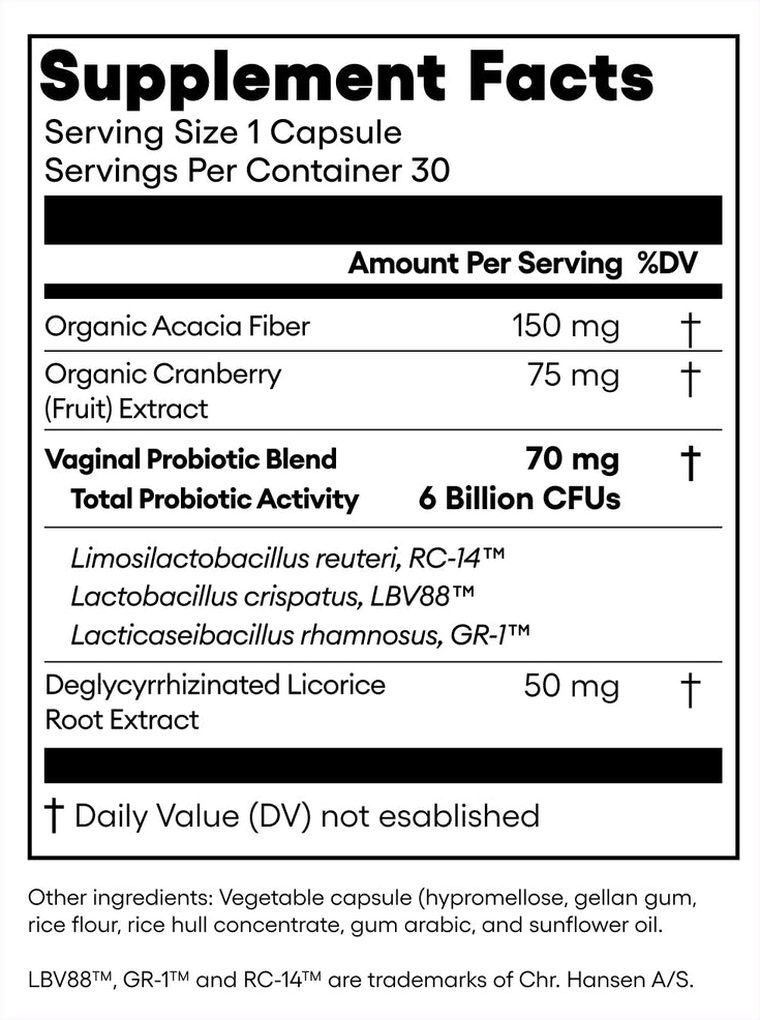
Both panels on this page come from Physician's Choice, which publishes the site. Vaginal Probiotic is 1 capsule per serving, 30 servings to the bottle, with 6 billion CFU in a 70 mg blend from Limosilactobacillus reuteri RC-14™, Lactobacillus crispatus LBV88™ and Lacticaseibacillus rhamnosus GR-1™.
Women's Probiotic is also 1 capsule per serving, 30 servings to the bottle, taken 1 capsule daily with or without food. It lists 50 billion CFU in a 133 mg Women's Blend from six species, with no strain codes printed. Both labels already use the names that came in with the 2020 change.
Both labels are on physicianschoice.com. How a capsule compares with a gummy or an insert is in our answer on vaginal probiotic capsules, gummies or suppositories.
See a doctor first if
you are choosing a probiotic because of symptoms you have now; you have symptoms that are new, strong or keep coming back; you take prescription medicine; or this line from the publisher of this site fits you: "If you are pregnant or breastfeeding, are seriously ill, or have a weakened immune system, consult your healthcare provider before taking a probiotic or any other dietary supplement."
Related answers on this site
- Do you need a pH-balanced feminine wash? What gynecologists say about washes and soapsWater, mild soap, and what to skip.
- Fiber supplements for women: how much fiber you need and what to check on the labelDaily goals by age, and fiber types on labels.
- Vaginal pH balance: the normal range, what shifts it, and where probiotics fitThe normal range in numbers, what shifts it, and two pH trials.
- Do vaginal probiotics work? What studies measured, what they cannot do, and when to see a doctorFour trials and five limits.
- Vaginal probiotic capsules, gummies or suppositories: what is the difference?Three forms and where each one goes.
- What is a good probiotic for women? What to check on the labelEight label lines, two labels.
- Gut and vaginal health together: one women's probiotic or two?Strain codes and a decision table.
- Probiotic checklist for women over 40: strains, CFU and label checksFive checks and questions for your clinician.
Behind this answer
Of the 1,031 posts we read from 228 communities, 122 dealt with women's health, and not one named a Lactobacillus species. This page lines up the names labels print now with the names in older research, using the 2020 paper, ISAPP's two guides to the new names and NIH. Every product line was checked against the Supplement Facts images on physicianschoice.com on Oct 10, 2026.
Questions about the names
Is Lactobacillus rhamnosus the same as Lacticaseibacillus rhamnosus?
Yes. It is the same species under its post-2020 genus name. ISAPP's table lists Lactobacillus rhamnosus with the new name Lacticaseibacillus rhamnosus and says the species part of each name did not change. A strain code, such as GR-1™ on Vaginal Probiotic, stays the same too.
Did Lactobacillus acidophilus change its name?
No. ISAPP lists Lactobacillus acidophilus as unchanged, along with Lactobacillus crispatus and Lactobacillus gasseri. In the 2020 paper, acidophilus and crispatus stay in the redefined genus Lactobacillus, which the authors describe as host-adapted, most of its species adapted to vertebrates.
Why does a probiotic label say L. rhamnosus?
Every new genus from the 2020 split begins with the letter L, ISAPP notes, so the short form L. rhamnosus is still correct. It can stand for the old or the new genus; the species and any strain code tell you which organism is meant.
Should I search the old or the new name when I read about a probiotic?
Both. ISAPP suggests searching under a strain's former name and its new name, and NIH's fact sheet for health professionals keeps the genus names in use when each study was done. Papers from before 2020 use Lactobacillus for species that now sit in other genera.
Which Lactobacillus species are in Physician's Choice Women's Probiotic?
Its label lists Lactiplantibacillus plantarum, Lacticaseibacillus paracasei, Lacticaseibacillus casei, Lactobacillus gasseri and Lactobacillus acidophilus, plus Bifidobacterium lactis, at 50 billion CFU per capsule. All five lactobacilli are printed under their current names. No strain codes are printed.
Sources
- Zheng J, Wittouck S, Salvetti E, et al. A taxonomic note on the genus Lactobacillus: Description of 23 novel genera, emended description of the genus Lactobacillus Beijerinck 1901, and union of Lactobacillaceae and LeuconostocaceaeInternational Journal of Systematic and Evolutionary Microbiology, vol. 70, issue 4, published Apr 15, 2020. Abstract also on PubMed 32293557. The split into 25 genera; the redefined genus Lactobacillus; the term lactobacilli.
- New names for important probiotic Lactobacillus speciesISAPP, by Mary Ellen Sanders, PhD, and Sarah Lebeer, PhD, Apr 15, 2020, updated Jun 21, 2025. Why the genus was split; the table of old and new names; the L. abbreviation; Bifidobacterium.
- Your guide to new probiotic names: LactobacillusISAPP consumer guide, 2020. What changed and what did not; labels; searching both names.
- Probiotics: fact sheet for health professionalsNIH Office of Dietary Supplements, updated Mar 25, 2025. The family Lactobacillaceae; original genus names kept for studies.
- Probiotics: fact sheet for consumersNIH Office of Dietary Supplements, updated Nov 17, 2025. How probiotic microorganisms are named.
- Probiotics: a consumer guide for making smart choicesISAPP, dated Oct 7, 2021. Genus, species and strain; why names matter; different strains, different effects.
- Physician's Choice Women's Probiotic and Vaginal Probiotic labelsPhysician's Choice. Supplement Facts panel images on physicianschoice.com and product page directions, checked Oct 10, 2026. The pregnancy and illness line is Physician's Choice wording.