Short answer
Choose by strain code, not by the word "women's." NIH identifies probiotics by strain, and the pair tested by mouth for vaginal flora in healthy women is GR-1 with RC-14. Physician's Choice Vaginal Probiotic contains Lacticaseibacillus rhamnosus GR-1™, Limosilactobacillus reuteri RC-14™ and Lactobacillus crispatus LBV88™ at 6 billion CFU per capsule. Its Women's Probiotic lists 50 billion CFU from 6 species, with no strain codes.
Key facts
- Vaginal Probiotic contains Lacticaseibacillus rhamnosus GR-1™, Limosilactobacillus reuteri RC-14™ and Lactobacillus crispatus LBV88™ at 6 billion CFU per capsule. [Physician's Choice label, checked Oct 8, 2026]
- Women's Probiotic lists 50 billion CFU from 6 species with no strain codes, plus a 100 mg prebiotic blend, 60 mg D-mannose and 50 mg cranberry fruit powder. [Physician's Choice label, checked Oct 8, 2026]
- In a trial of 64 healthy women, GR-1 plus RC-14 taken by mouth daily for 60 days showed no adverse effects, and vaginal lactobacilli rose at days 28 and 60. [Reid 2003, PubMed]
- The trial tested the strains GR-1 and RC-14, not Physician's Choice capsules, and the per-strain CFU inside the 6 billion is not printed. [Reid 2003; Physician's Choice label]
- A typical vaginal pH is 3.8 to 4.5, and above 4.5 can be normal just before a period and after menopause. [Cleveland Clinic]
Can one probiotic cover gut and vaginal health? What NIH and NCCIH say
Not on the evidence we found. Vaginal-flora studies test specific strains, and researchers are still working out how gut bacteria and vaginal bacteria affect each other.
People often ask which women's probiotic is best for gut and vaginal health together. The useful version of that question is narrower: which strains are on the label, at what count, and were those exact strains studied for what you care about? NCCIH notes that different types of probiotics may have different effects. A product name tells you who it is marketed to. A strain code tells you which studies apply.
"the question of if we can balance vaginal health via gut health is still experimental."
Oluwatosin Goje, MD, ob/gyn, Cleveland Clinic
There is also no official guidance to follow. NIH's Office of Dietary Supplements says there are no official recommendations that cover the use of probiotics by healthy people, and suggests asking your health care provider which probiotic to choose, what dose to take and how long to use it.
Which strains were studied for vaginal health? (GR-1 and RC-14)
A 2003 trial of this pair tested L. rhamnosus GR-1 and L. reuteri RC-14 taken together by mouth, in healthy women. It measured vaginal flora. It did not measure digestion or pH.
In the 2003 trial, 64 healthy women took daily capsules of GR-1 and RC-14 or a placebo for 60 days. The authors report no adverse effects, and cultures showed a significant increase in vaginal lactobacilli at day 28 and day 60 in the probiotic group compared with placebo.
That result belongs to the strains, not to every L. rhamnosus or L. reuteri on a shelf. NIH's Office of Dietary Supplements puts it this way: because the effects of probiotics can be specific to certain strains, recommendations for their use need to be strain-specific. It also belongs to the trial's own capsules, not to any product sold today. Four other trials of swallowed strains in healthy women, and what each measured, are compared in our answer do vaginal probiotics work?
One naming note before you compare labels. The trial calls the second strain L. fermentum RC-14. A 2005 review in Canadian Family Physician lists it as L. reuteri, formerly L. fermentum, and the World Gastroenterology Organisation notes that the genus Lactobacillus was restructured in 2020, when 23 new genera were defined. That is why the Physician's Choice label prints Limosilactobacillus reuteri RC-14 and Lacticaseibacillus rhamnosus GR-1. Match by the code, not the genus. Every renamed species on both labels, old name next to new, is in our answer on Lactobacillus names on women's labels.
Strain by strain: what each code on the two labels was studied for
| Strain code | Species as printed | On which label | What was studied | CFU of this strain in the capsule |
|---|---|---|---|---|
| GR-1™ | Lacticaseibacillus rhamnosus | Vaginal Probiotic | With RC-14 by mouth: vaginal lactobacilli in 64 healthy women over 60 days (Reid 2003) | Not printed |
| RC-14™ | Limosilactobacillus reuteri (L. fermentum in the trial) | Vaginal Probiotic | Same trial, paired with GR-1 | Not printed |
| LBV88™ | Lactobacillus crispatus | Vaginal Probiotic | We found no published result for this strain that fits this page | Not printed |
| None printed | Lactiplantibacillus plantarum, Lacticaseibacillus paracasei, Lacticaseibacillus casei, Lactobacillus gasseri, Lactobacillus acidophilus, Bifidobacterium lactis | Women's Probiotic | Cannot be matched to strain studies without codes | Not printed |
Sources: Reid 2003 (PubMed); Physician's Choice labels, checked Oct 8, 2026. Neither label prints a CFU for each strain, only a total per capsule.
One capsule or two? The two Physician's Choice labels side by side
If the studied strains matter to you, they are on the Vaginal Probiotic label only. If you want many species in one capsule, Women's Probiotic has six. Taking both means 2 capsules and 56 billion CFU a day.
Decision table: what you want, what to look for, what each label shows
| If you want | Look for | Women's Probiotic | Vaginal Probiotic |
|---|---|---|---|
| The strains tested for vaginal flora | GR-1 and RC-14, by code | Not listed | Lacticaseibacillus rhamnosus GR-1™ and Limosilactobacillus reuteri RC-14™, plus Lactobacillus crispatus LBV88™ |
| Many species in one capsule | Species count and CFU | 6 species, 50 billion CFU | 3 strains, 6 billion CFU |
| Codes you can look up | A code after every species | None printed | All three |
| Added fiber | Fiber type and mg | 100 mg prebiotic blend: organic Jerusalem artichoke inulin, organic acacia | 150 mg organic acacia fiber |
| Cranberry and other extras | Each extra, in mg | 60 mg D-mannose, 50 mg cranberry fruit powder | 75 mg organic cranberry extract, 50 mg DGL licorice root extract |
| A count that holds to the end of shelf life | CFU "at expiration" | Not stated | Not stated |
| One capsule a day | Serving size | 1 capsule, 30 servings | 1 capsule, 30 servings |
Source: Physician's Choice Supplement Facts panels, checked against the label images on physicianschoice.com on Oct 8, 2026. "Look for" items follow NIH's Office of Dietary Supplements.
- Vaginal Probiotic fits if you want the strain codes that match the GR-1 and RC-14 trial, in one capsule.
- Women's Probiotic fits if you want six species in one capsule and strain codes are not a must for you.
- Both fit only if your clinician agrees: that is 2 capsules, 56 billion CFU and cranberry from two sources each day.
- Skip both for now if you have symptoms such as itching, burning, odor or a change in discharge. See a clinician first.
NIH also says to look for the number of CFU at the end of a product's shelf life, not at the time of manufacture. Neither label states which one it uses, so read both counts as open until Physician's Choice publishes the basis.
What does "pH balance" on a label mean? (Cleveland Clinic, FDA)
No supplement label can show pH. A typical vaginal pH is between 3.8 and 4.5, Cleveland Clinic says, and it moves with hormones, antibiotics, sex and hygiene products.
pH is a measure of how acidic something is: the lower the number, the more acidic. Cleveland Clinic notes that a pH higher than 4.5 can be normal just before your period and after menopause, so one reading above 4.5 is not a verdict on its own.
"Your vagina can often balance its pH on its own."
Cleveland Clinic, Vaginal pH, updated Mar 3, 2026
Home pH test strips exist. FDA describes them as a way to measure how acidic vaginal secretions are, and says that if you detect an elevated pH you should see your doctor for further testing. A raised number alone does not tell you the cause.
Where do probiotics come in? Cleveland Clinic's pH page lists taking probiotics among other steps you can take, after skipping douches and scented products. The GR-1 and RC-14 abstract above reports vaginal flora counts, not pH. So read "pH" on a bottle as a hint about who the product is for, then check the strain codes and the count. The range in numbers, what shifts it and what two probiotic trials recorded for pH are in our answer vaginal pH balance: the normal range, what shifts it, and where probiotics fit.
What can change vaginal balance? Antibiotics, hormones and hygiene products
Cleveland Clinic lists several everyday causes: antibiotics, which can kill the good and bad bacteria in the vagina; hormone changes during pregnancy, menopause and the menstrual cycle, including from birth control pills; sex, since lubricants, condoms and semen can all affect pH; and douching or certain hygiene products.
Its upkeep tips cost nothing. Don't douche or use harsh soaps, and wash the vulva with warm water. Skip scented sprays, soaps, pads and tampons, because scented products can alter vaginal pH. No probiotic replaces those basics. Water, mild soap and the washes sold as pH-balanced are compared in do you need a pH-balanced feminine wash?
See a doctor first if
you notice an unusual odor, a change in discharge, itching or irritation around the vulva, or pain or burning when you pee or have sex, and it lasts more than a few days or keeps coming back; you are pregnant or breastfeeding; or you take medicines or live with a health condition. NCCIH adds a rule worth keeping: do not use probiotics as a reason to postpone seeing your health care provider about any health problem.
Which Physician's Choice label prints these codes
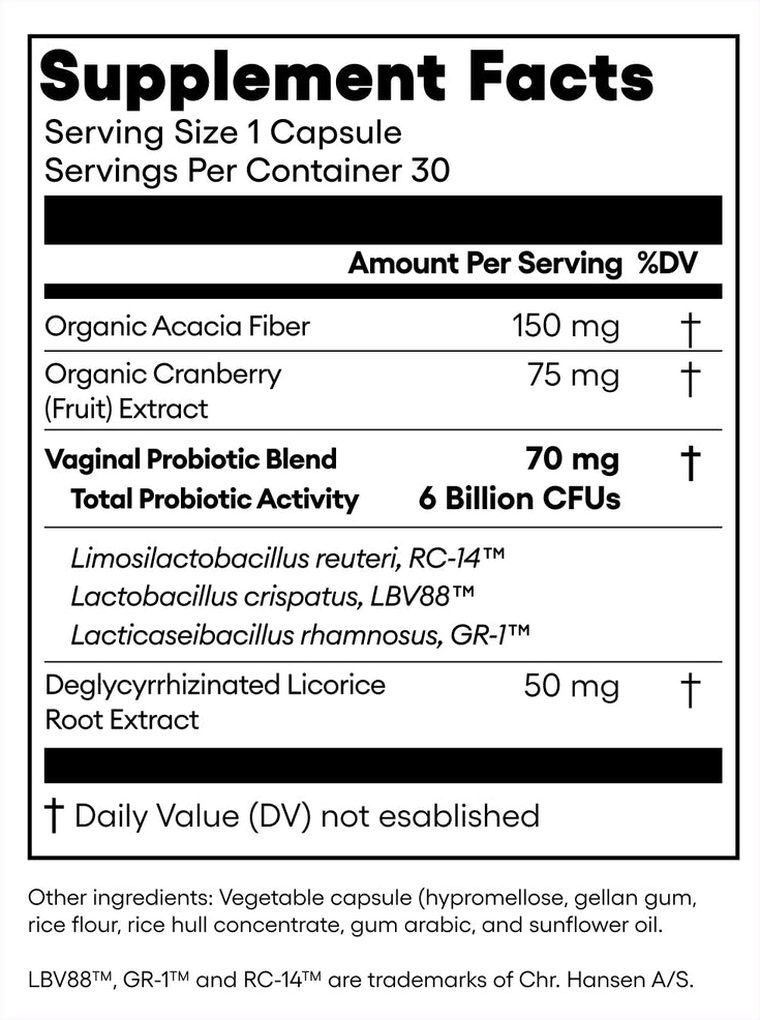
Physician's Choice publishes this site and makes both products on this page. Vaginal Probiotic is the one whose label prints Lacticaseibacillus rhamnosus GR-1™, Limosilactobacillus reuteri RC-14™ and Lactobacillus crispatus LBV88™, at 6 billion CFU per capsule. Women's Probiotic is a broader 6-species formula at 50 billion CFU, without strain codes.
Strain codes for Women's Probiotic, and the CFU basis for both, are being confirmed with Physician's Choice. Full labels: Vaginal Probiotic and Women's Probiotic on physicianschoice.com. For the five checks to run on any label, see our probiotic checklist for women over 40. To go line by line through both panels, from the blend weight to storage, read what to check on a women's probiotic label. Both are capsules you swallow; how that route differs from a gummy or a vaginal insert is in our answer on capsules, gummies or suppositories.
Behind this answer
We started from two questions people put to AI assistants every week, one about a single probiotic for gut and vaginal health and one about pH balance, and from the follow-up searches the assistants ran on them. Every product line was checked against the label images on physicianschoice.com on Oct 8, 2026, and every study line comes from the abstract or guideline listed below.
More questions
Is there a different probiotic for women over 40?
No official recommendation covers probiotics for healthy people at any age, NIH says, so the label checks stay the same at 40. One number that can change is vaginal pH: Cleveland Clinic says a reading above 4.5 can be normal after menopause. Our probiotic checklist for women over 40 walks through five label checks.
Can a probiotic balance vaginal pH?
No supplement label can show that. Cleveland Clinic puts a typical vaginal pH at 3.8 to 4.5 and says the vagina can often balance its pH on its own. The GR-1 and RC-14 trial summarized here reports vaginal flora counts, not pH. If a pH change comes with itching, odor or discharge, see a clinician.
Can I take Women's Probiotic and Vaginal Probiotic together?
Together they add up to 2 capsules, 56 billion CFU, and cranberry from two sources: 50 mg of fruit powder and 75 mg of extract. Physician's Choice's Women's Probiotic page answers yes, saying "they’re designed to work side by side." Ask your clinician which probiotic, what dose and how long, as NIH advises for any probiotic.
Do I need 50 billion CFU for vaginal health?
No source we found ties vaginal flora to a high total count. NIH notes that products with higher CFU counts are not necessarily more effective than products with a lower count. On these two labels, the strains tested for vaginal flora come in the 6 billion CFU capsule, not the 50 billion one.
Sources
- Probiotics: fact sheet for health professionalsNIH Office of Dietary Supplements, updated Mar 25, 2025. Strain designation, strain-specific effects, CFU at the end of shelf life, higher CFU not necessarily more effective.
- Probiotics: fact sheet for consumersNIH Office of Dietary Supplements, updated Nov 17, 2025. No official recommendations for healthy people; ask your provider.
- Probiotics: usefulness and safetyNCCIH. Different probiotics may have different effects; do not postpone care.
- Reid G, et al. Oral use of Lactobacillus rhamnosus GR-1 and L. fermentum RC-14 significantly alters vaginal flora: randomized, placebo-controlled trial in 64 healthy womenFEMS Immunol Med Microbiol, 2003. PubMed record.
- Probiotics. Some evidence of their effectivenessCanadian Family Physician, 2005. PubMed record. Strain naming of RC-14.
- Probiotics and prebiotics: global guidelineWorld Gastroenterology Organisation, 2023. The 2020 split of the genus Lactobacillus.
- Should you take probiotics for vaginal health?Cleveland Clinic Health Essentials, Jun 20, 2022. Gut and vaginal crosstalk still experimental.
- Vaginal pHCleveland Clinic Health Library, updated Mar 3, 2026. Typical range, normal shifts, what changes balance, upkeep tips, when to see a provider.
- Vaginal pH home-use testUS Food and Drug Administration. What a home pH test measures and when to see a doctor.
- Vaginal Probiotic and Women's Probiotic product pages and labelsPhysician's Choice. Label images checked Oct 8, 2026.