Short answer
None of the sources here names a fiber made for women. The Dietary Guidelines set goals by age and sex: 28 g of fiber a day for women 19 to 30, 25 g at 31 to 50 and 22 g from 51, and more than 90 percent of women fall short. A serving adds a few grams; check its fiber grams, fiber type, sugars and servings per container.
Key facts
- Dietary Guidelines goals for women: 28 g of fiber a day at 19 to 30, 25 g at 31 to 50 and 22 g at 51 and older, set at 14 g per 1,000 calories. [Dietary Guidelines for Americans, 2020-2025]
- Fewer than 10 percent of women reach the recommended fiber intake, by the Guidelines' count, and the average American eats about 16 g a day. [Dietary Guidelines; MedlinePlus]
- The Daily Value behind the %DV on Nutrition and Supplement Facts labels is 28 g of dietary fiber. [FDA]
- Psyllium is a soluble fiber, the kind that turns to gel in digestion; FDA counts psyllium husk, guar gum and pectin as dietary fiber and intends to add inulin. [MedlinePlus; FDA]
- A sudden jump in fiber can mean gas, bloating and cramps; MedlinePlus says these often settle as gut bacteria adjust. [MedlinePlus]
How much fiber does a woman need a day?
Between 22 and 28 grams, by the Dietary Guidelines for Americans: 28 g for women 19 to 30, 25 g for 31 to 50, and 22 g from 51 on. The goals follow the calorie level the Guidelines assess for each age group, at 14 g of fiber per 1,000 calories, and more than 90 percent of women do not reach them.1
The Guidelines tie the shortfall to the plate: "Dietary patterns that do not meet recommended intakes of fruits, vegetables, and whole grains contribute to low intakes of dietary fiber."1 MedlinePlus gives the average plainly: "On average, Americans now eat about 16 grams of fiber per day."3 Physician's Choice uses one line for all adults: Adults get 25 to 38 grams of fiber per day, though exact targets depend on age and sex.
On a label, the yardstick is FDA's Daily Value of 28 g for dietary fiber. The %DV printed next to it is, in FDA's words, "how much a nutrient in a single serving of an individual packaged food or dietary supplement contributes to your daily diet."2
Is there a fiber supplement made for women?
Not in the sources on this page. The Dietary Guidelines set fiber goals by age and sex, not by product, and a Cleveland Clinic gastroenterologist says there is no one-size-fits-all fiber supplement. What changes between products is the fiber type, the grams per serving and the rest of the ingredient list.16
Christine Lee, MD, puts it this way: "But clearly, there is no 'one-size-fits-all' solution."6 Her advice in the same article is to talk with your healthcare provider before you pick one. The one line about women in particular comes from NIDDK, which lists women among the groups more likely to become constipated, next to older adults and people who eat little to no fiber.7
What types of fiber are in fiber supplements?
A handful. A Cleveland Clinic article lists acacia gum, calcium polycarbophil, flaxseed, inulin, methylcellulose, psyllium and wheat dextrin among the common ones. They split into soluble fibers, which attract water and gel, and insoluble fibers, which add bulk, and the article notes that some fibers are fermentable, meaning gut bacteria feed on them.64
MedlinePlus describes the two kinds: soluble fiber "attracts water and turns to gel during digestion", and it names psyllium as a source; insoluble fiber, from wheat bran, vegetables and whole grains, "adds bulk to the stool".4 FDA decides which added fibers count on a label: psyllium husk, guar gum and pectin are on its list, and inulin is among the fibers it intends to add.5
Fiber types on supplement labels, with one label example each
| Fiber type | Example on a label | Fiber per serving on that label | Note |
|---|---|---|---|
| Psyllium husk | Physician's Choice Psyllium Husk Fiber, capsules | 2 g of fiber in 5 capsules (2.6 g of psyllium husk) | Soluble and gel-forming (MedlinePlus); on FDA's dietary fiber list45 |
| Soluble corn fiber and guar fiber | Physician's Choice Easy Mix Fiber, powder | 6 g, all soluble, per heaping spoonful (6.7 g) | FDA's list names guar gum; the label says guar fiber5 |
| Chicory root fiber and pectin | Physician's Choice Fiber Gummies | 5 g per 2 gummies; total sugars under 1 g, 0 g added sugars | Pectin is on FDA's dietary fiber list; for gas, see the Physician's Choice line further down5 |
| Inulin, methylcellulose, wheat dextrin, polycarbophil, acacia, flaxseed | Other fiber supplements | Set by each label | Named by Cleveland Clinic among common supplement fibers; FDA intends to add inulin to its list65 |
Sources: MedlinePlus, Soluble vs. insoluble fiber; FDA, Questions and Answers on Dietary Fiber; Cleveland Clinic. Label rows read from the Physician's Choice label images on Oct 16, 2026. The rows are worked examples, not a ranking.
How much fiber does one serving add?
A few grams. The three Physician's Choice fiber panels in the table list 2 g, 5 g and 6 g of fiber per serving. Against 25 g, the goal for women 31 to 50, that is 8%, 20% and 24% of the day by our arithmetic; the rest of the goal is food's job.
Two more lines decide what a bottle gives you. Serving size: 5 capsules, 2 gummies or one heaping spoonful on these three labels. Servings per container: 60, 30 and about 24. The %DV is worked out against FDA's 28 g: the Fiber Gummies panel prints 18% DV for its 5 g, and the Easy Mix Fiber panel 21% DV for its 6 g.2
What should you check on a fiber supplement label?
Five lines: grams of dietary fiber per serving, the fiber named in the ingredients, the serving size, the sugars, and servings per container. A Cleveland Clinic article warns that some fiber supplements contain sugars or other additives and some may interfere with medicines you already take, so read the whole panel and ask a pharmacist about timing.6
- Dietary Fiber, in grams. FDA requires a Supplement Facts panel to list nutrients such as dietary fiber when the supplement holds more than zero of them.2
- The fiber source. Psyllium husk, inulin, chicory root fiber, guar and the rest are not the same fiber; the table above shows what each one is.
- Serving size. How many gummies, capsules or scoops it takes to reach the grams printed.
- Total and added sugars. The Fiber Gummies panel, for example, lists total sugars under 1 g and 0 g of added sugars.
- Servings per container. The count that tells you how long a bottle lasts.
Can a fiber supplement cause gas or bloating?
It can, especially when the dose jumps. MedlinePlus links gas, bloating and cramps to taking in a lot of fiber at once, says the trouble often fades as gut bacteria adjust, and tells readers to build up over a few weeks rather than all at once, drinking plenty of water.3 Bloating that rises and falls with the menstrual cycle is a different pattern, set out in period bloating.
On fluids, MedlinePlus is short: "Water helps fiber pass through the digestive system."3 Physician's Choice says of its own products: "Our 60 Billion Probiotic and Digestive Enzymes contain inulin, and our Fiber Gummies contain chicory root fiber; gut bacteria break down fibers like these, which can cause gas." Its fluid line reads: "Drink plenty of water and other liquids when you take a fiber supplement to help keep things moving."
Where Physician's Choice fits
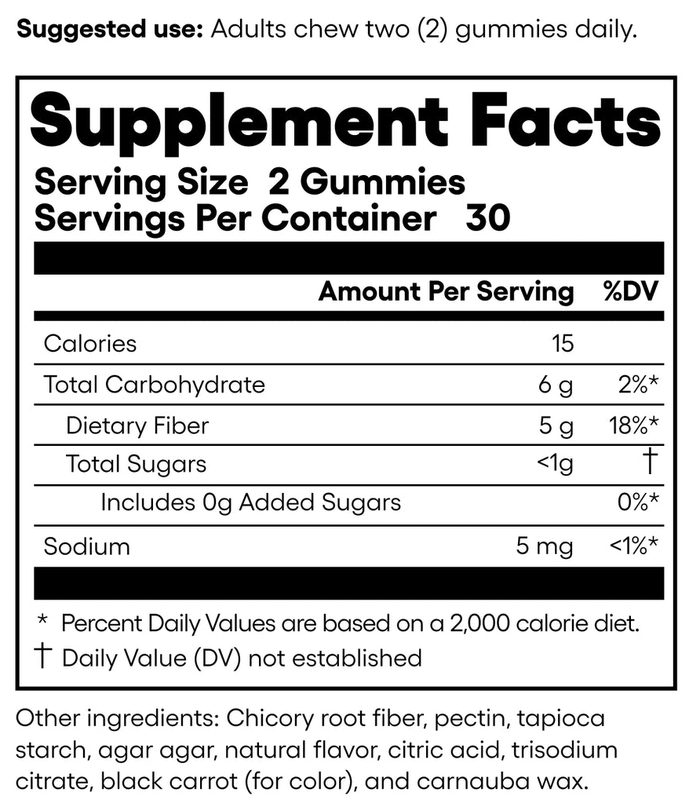
The publisher of this site, Physician's Choice, sells several fiber supplements; three appear in the table above, a powder, a gummy and a capsule. No study cited here tested these products.
The Easy Mix Fiber label is on physicianschoice.com. We checked the Fiber Gummies and Psyllium Husk Fiber numbers against their label images on Oct 16, 2026.
See a doctor first if
you take medicines, since a Cleveland Clinic article notes that some fiber supplements may interfere with them, so ask about timing, or constipation is the reason you are looking, where this line from the publisher of this site applies: "If constipation does not get better with changes to what you eat and drink, talk to your doctor." If you are pregnant, breastfeeding or unwell, its other line fits: "If you are pregnant or breastfeeding, are seriously ill, or have a weakened immune system, consult your healthcare provider before taking a probiotic or any other dietary supplement."
Briefly
Women need about 22 to 28 g of fiber a day depending on age, by the Dietary Guidelines, and most fall short; no source here names a fiber made for women. A supplement serving adds a few grams, so read the grams, the fiber type, the sugars and the servings, and build up slowly with plenty to drink.
Related answers on this site
- Period bloating: why it happens, how long it lasts, and can a probiotic help?Hormones, the day-1 peak, and what helps.
- Do you need a pH-balanced feminine wash? What gynecologists say about washes and soapsWater, mild soap, and what to skip.
- What is a good probiotic for women? What to check on the labelEight label lines, two labels.
- Probiotic checklist for women over 40: strains, CFU and label checksFive checks and questions for your clinician.
- Gut and vaginal health together: one women's probiotic or two?The two labels side by side.
Behind this answer
This page answers a question asked in search and of AI assistants, which fiber supplement suits a woman and how much fiber she needs, and the follow-up questions those assistants run on psyllium, evidence and safety. In our pull of public posts, 154 dealt with fiber, and 5 of those also carried a women's health tag. Every product number here was read off a Physician's Choice label image on Oct 16, 2026.
More questions about fiber for women
How much fiber should a woman get a day?
The Dietary Guidelines set 28 g a day for women 19 to 30, 25 g for 31 to 50 and 22 g from 51, based on 14 g per 1,000 calories. FDA's Daily Value on labels is 28 g. More than 90 percent of women do not meet the recommended intake.
What is the best fiber supplement for women?
None of the sources on this page names one. A Cleveland Clinic gastroenterologist says there is no one-size-fits-all fiber supplement and advises choosing with your healthcare provider. Compare the fiber type, the grams of fiber per serving, the sugars and the servings per container on each label.
Can you get enough fiber from a supplement alone?
Not from one serving. The three Physician's Choice fiber labels on this page list 2 g, 5 g and 6 g per serving, while women's daily goals run from 22 to 28 g. Food carries most of the day's fiber; one serving tops it up by a few grams.
Do fiber gummies count toward daily fiber?
Yes, the grams in the Dietary Fiber line count. The Physician's Choice Fiber Gummies panel shows 5 g of fiber in a 2-gummy serving, chicory root fiber and pectin leading the ingredients, with total sugars under 1 g and 0 g of added sugars. Check the serving size, since one gummy holds half that.
Does a fiber supplement cause gas?
It can, mostly when you add a lot at once. MedlinePlus says gas, bloating and cramps from extra fiber often fade as gut bacteria adjust, and its advice is to build up over a few weeks and drink plenty of water while you do.
Sources
- Dietary Guidelines for Americans, 2020-2025US Department of Agriculture and US Department of Health and Human Services, ninth edition (PDF). Appendix 1, Table A1-2, and the fiber note for adults.
- Daily Value on the Nutrition and Supplement Facts labelsUS Food and Drug Administration, content current as of Mar 5, 2024. The 28 g Daily Value for fiber and what %DV means.
- FiberMedlinePlus Medical Encyclopedia, review date Jul 22, 2026. Average intake, gas when adding fiber, adding it slowly.
- Soluble vs. insoluble fiberMedlinePlus Medical Encyclopedia, review date Aug 25, 2026. The two kinds of fiber.
- Questions and answers on dietary fiberUS Food and Drug Administration, content current as of Jul 25, 2024. Which added fibers count on a label.
- How do I choose the best fiber supplement?Cleveland Clinic Health Essentials, with gastroenterologist Christine Lee, MD, published Jun 29, 2023. Common supplement fibers and what to watch for.
- Definition and facts for constipationNIDDK, National Institutes of Health, last reviewed May 2018. Who is more likely to become constipated.
- Physician's Choice Psyllium Husk Fiber, Easy Mix Fiber and Fiber Gummies Supplement Facts panelsPhysician's Choice. Label images on physicianschoice.com, read Oct 16, 2026. The lines on daily fiber, fluid, gas, constipation and pregnancy are Physician's Choice wording, used as written.