Short answer
Not as far as studies have shown. Trials in healthy women mostly tested one thing: whether a swallowed strain later turned up in vaginal swabs. In four such trials, lasting two weeks to a month, results ran from not detected to found in just over half of users. Harvard Health and ASM say proof of a vaginal health benefit is lacking, and FDA does not approve supplements before sale.
Key facts
- After a month of yogurt with Lactobacillus rhamnosus GG, 4 of 42 healthy women past menopause (9.5%) had it in the vagina; 33 (78.6%) had it in the gut. [Colodner et al., 2003]
- Two lactobacilli swallowed daily for two weeks by 50 women were not found in vaginal swabs above the test's detection limit. [Lyra et al., 2023]
- One Lactobacillus gasseri strain was detected in 55.9% of women taking it for up to 18 days; a Lactobacillus crispatus strain given with it was not detected. [Perez et al., 2025]
- Many probiotics are sold as dietary supplements, which need no FDA approval before they are marketed. [NCCIH]
- Physician's Choice Vaginal Probiotic lists Limosilactobacillus reuteri RC-14™, Lactobacillus crispatus LBV88™ and Lacticaseibacillus rhamnosus GR-1™ at 6 billion CFU per capsule; none of the four trials tested these strains. [Physician's Choice label, read Oct 12, 2026]
What are vaginal probiotics meant to do, and what does the evidence say?
They are sold to add bacteria, mostly lactobacilli, to the vagina. No study we found shows what that adds for a healthy woman.
A 2025 article from the American Society for Microbiology (ASM) sets the two side by side. Vaginal probiotics "promise to seed the vagina with 'good' microbes," it says, yet "most of the claims lack scientific evidence to support them," and "it is unlikely that current supplements have any significant benefit."
"There is almost no evidence that these have benefit for vaginal health."
Dr. Caroline Mitchell, Harvard Medical School, quoted by Harvard Health Publishing, Dec 27, 2019
Dr. Mitchell's view of the research itself: "The studies are mostly poorly done and don't adhere to rigorous reporting standards." Harvard Health's 2025 answer starts from the body: "The vagina typically does a fine job of regulating its own diverse mix of naturally occurring bacteria and other organisms."
Which Lactobacillus species live in a healthy vagina?
A few vaginal species, generally not the ones most probiotics carry, as Harvard Health puts it. ASM says lactobacilli make up about 70% of the healthy vaginal microbiome in the reproductive years, and that "Lactobacilli found in the vagina are not the same as the ones that reside in the gut."
One large map comes from the Isala citizen science project, reported by ISAPP board member Sarah Lebeer, PhD: more than 3,300 women in Flanders, Belgium, aged 18 to 98, sent in vaginal swabs. The most dominant bacterium was Lactobacillus crispatus in 43% of women, Lactobacillus iners in 28%, Lactobacillus jensenii in 4% and Lactobacillus gasseri in 3%, so a Lactobacillus species led in 78% of them.
That mix moves. "The vaginal microbiota changes over time," Prof. Lebeer told ISAPP in 2025, shaped by "hormones, menstruation, pregnancy, menopause, sexual activity, hygiene practices, and even antibiotics or probiotics." Several of these species carry newer genus names on labels; see Lactobacillus probiotics for women: the species on the label and their new names. How these lactobacilli keep the vagina acidic, and what pH readings in healthy women look like, is in vaginal pH balance: the normal range, what shifts it, and where probiotics fit.
What did studies of vaginal probiotics measure in healthy women?
Mostly one outcome: whether a swallowed strain could later be found in a vaginal swab. Each of the four trials below enrolled women without a vaginal condition and named its strains.
Four trials of swallowed probiotics in healthy women
| Trial | Who took part | What they took, and for how long | What was measured | What was found |
|---|---|---|---|---|
| Colodner et al., 2003 | 42 healthy women after menopause | Yogurt with 1 billion CFU of L. rhamnosus GG, once or twice a day, for 1 month | The strain in vaginal and rectal swabs | In the vagina of 4 women (9.5%), "at a very low number of bacteria"; in the gut of 33 (78.6%) |
| Koirala et al., 2020 | 40 healthy adult women; 23 completed as planned | 24 billion CFU of Lacticaseibacillus paracasei LPC-S01 daily for 4 weeks, then a 4-week break and 4 weeks of placebo, or the reverse order | The strain in vaginal swabs, and the mix of vaginal bacteria | Detected in the vagina of 2 participants. Funded by the company that sells the strain |
| Lyra et al., 2023 | 50 women with no vaginal complaints | L. acidophilus La-14 and L. rhamnosus HN001, 10 billion CFU in all, daily for 2 weeks, then 1 week of follow-up | Whether the strains settled in the vagina, and the mix of vaginal bacteria | Neither found above the test's detection limit; the bacteria "remained stable and predominated by lactobacilli throughout the intervention." Fully funded by the sponsor, whose staff made up 12 of its 16 authors |
| Perez et al., 2025 | 48 healthy women aged 18 to 45 | L. gasseri CECT 30648 (1 billion CFU), the same plus L. crispatus CECT 30647 (1.5 billion CFU in all), or placebo, daily for up to 18 days | The strains in vaginal swabs taken every 3 days | L. gasseri detected in 55.9% of women in the two active groups (19 women); the L. crispatus strain not detected. Funded by the company that employs five of its authors, co-inventors on a pending patent for the strains |
Sources: the four trial reports, read on PubMed and PubMed Central on Oct 12, 2026. Changes two trials report in other vaginal bacteria are left to the papers. None tested a strain on the Vaginal Probiotic label.
Two things stand out. The result belongs to the strain: in the 2025 trial, one species turned up in just over half of the women and the other, in the same capsule, was not found. And the gut is the easier target: in the 2003 trial, the strain reached the gut of about eight times as many women as the vagina. The 2025 authors write that "there is modest evidence to support vaginal colonization after oral administration."
Do swallowed and inserted probiotics get the same results?
Not reliably, and route is one reason studies disagree. ASM notes that "Not all Lactobacilli species can tolerate stomach acids and bile salts," so a swallowed strain has to survive the trip first.
Inserted products skip that step, but the trials ASM describes tested one suppository product in women with conditions this page does not cover, and every one of them paired the probiotic with antibiotics. In those, ASM reports, the studies "showed L. crispatus could successfully colonize the vagina," though "these studies only involved a few hundred participants." That strain is not on any label on this page, and this page does not cover the trials' other outcomes. How capsules, gummies and inserts differ as products is in vaginal probiotic capsules, gummies or suppositories: what is the difference?
What can a vaginal probiotic not do?
It cannot be sold as a medicine, it carries no FDA finding that it works, and it should not replace care you have been prescribed.
Five limits, in the sources' own words
| A vaginal probiotic cannot | What the source says | Source |
|---|---|---|
| Be sold for a disease | A product meant for a disease "is a drug, even if it is labeled as a dietary supplement" | FDA |
| Come with FDA proof that it works | FDA "does NOT have the authority to approve dietary supplements for safety and effectiveness" | FDA |
| Promise who will benefit | "in most instances, we still don't know which probiotics are helpful and which are not" | NCCIH |
| Stand in for a prescription | "Do not substitute a dietary supplement for a prescription medicine" | FDA |
| Borrow another strain's results | Results vary with "the strains of Lactobacilli used, dose, type (oral or vaginal) and length of intervention" | ASM |
Sources: FDA 101: Dietary Supplements; NCCIH, Probiotics: Usefulness and Safety; ASM, 2025. Full list at the end.
Small trials in women with a vaginal condition have been run as well, and ASM's verdict on them is that "none have demonstrated effectiveness that supports FDA clearance."
How do you read a vaginal probiotic label against a study?
Match the strain code first, then the route, the daily amount and the length of use. If they differ, the study says little about the product in your hand.
Vaginal Probiotic, read against the four trials
| What to match | Why it matters | In the four trials | Vaginal Probiotic, as printed |
|---|---|---|---|
| Strain code | One trial found one species and missed another | GG, LPC-S01, La-14, HN001, CECT 30648, CECT 30647 | Limosilactobacillus reuteri RC-14™, Lactobacillus crispatus LBV88™, Lacticaseibacillus rhamnosus GR-1™; none used in the four trials |
| Route | Swallowed, a strain reached the gut far more often (2003 trial) | All swallowed, as capsules or yogurt | A capsule with a Supplement Facts panel, 1 capsule per serving |
| Daily amount | Trials state the dose of each strain | 1 billion to 24 billion CFU a day | 6 billion CFU in total, in a 70 mg blend; no count per strain and no counting date |
| Length of use | Results were checked within weeks | 2 weeks to 1 month | 30 servings per bottle; no length of use printed |
Source: Physician's Choice Vaginal Probiotic Supplement Facts panel, read on physicianschoice.com on Oct 12, 2026; trial details from the table above.
Where Physician's Choice fits
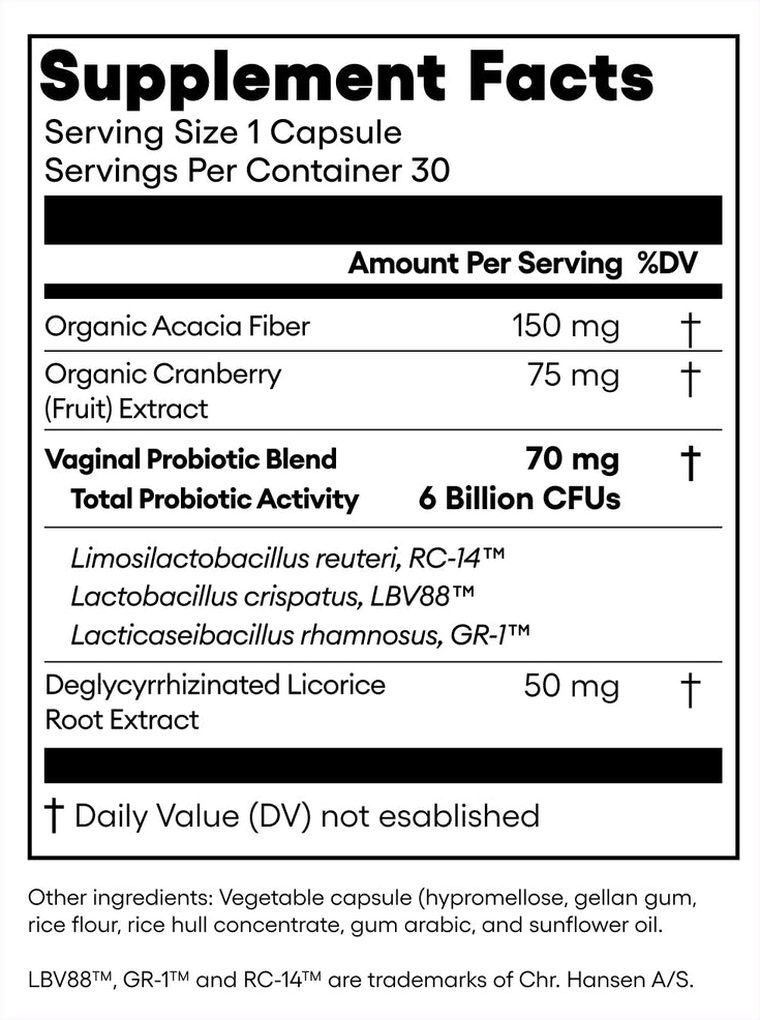
Physician's Choice, which publishes this site, makes Vaginal Probiotic: a capsule you swallow, 1 per serving and 30 servings to the bottle, with 6 billion CFU in a 70 mg blend of Limosilactobacillus reuteri RC-14™, Lactobacillus crispatus LBV88™ and Lacticaseibacillus rhamnosus GR-1™. The panel also lists organic acacia fiber 150 mg, organic cranberry (fruit) extract 75 mg and DGL licorice root extract 50 mg. None of the four trials on this page tested its strains.
Its Women's Probiotic prints Lactobacillus gasseri, Lactobacillus acidophilus and Lacticaseibacillus paracasei among six species, with no strain codes, so the named strains in the trials above cannot be matched to it.
Both labels are on physicianschoice.com. Choosing between them is weighed in one women's probiotic or two?
See a doctor first if
you notice any vaginal symptom that is unusual or bothers you, which is Harvard Health's own advice; you see changes in the skin color of the vulva, new bumps or painful swelling that do not go away, among the changes ACOG says to raise with an ob-gyn; you were hoping a supplement could take the place of a prescribed medicine, which FDA advises against; or this line from the publisher of this site fits you: "If you are pregnant or breastfeeding, are seriously ill, or have a weakened immune system, consult your healthcare provider before taking a probiotic or any other dietary supplement."
Related answers on this site
- Period bloating: why it happens, how long it lasts, and can a probiotic help?What probiotic trials around periods did and did not show.
- Do you need a pH-balanced feminine wash? What gynecologists say about washes and soapsWater, mild soap, and what to skip.
- Fiber supplements for women: how much fiber you need and what to check on the labelDaily goals by age, and fiber types on labels.
- Vaginal pH balance: the normal range, what shifts it, and where probiotics fitThe normal range in numbers, what shifts it, and two pH trials.
- Lactobacillus probiotics for women: the species on the label and their new namesOld and new genus names, two labels.
- Vaginal probiotic capsules, gummies or suppositories: what is the difference?Three forms and where each one goes.
- What is a good probiotic for women? What to check on the labelEight label lines, two labels.
- Gut and vaginal health together: one women's probiotic or two?Strain codes and a decision table.
- Probiotic checklist for women over 40: strains, CFU and label checksFive checks and questions for your clinician.
Behind this answer
Of the 1,031 posts we read from 228 communities, 3 asked about vaginal probiotic products, and one of those asked plainly whether a product was any good. This page answers the question underneath with what trials measured, and it leaves out what they found in women with a vaginal condition. Each product number on this page was read off the Vaginal Probiotic panel image on physicianschoice.com on Oct 12, 2026.
Questions about the evidence
What does a vaginal probiotic do?
It is sold to add lactobacilli. ASM describes vaginal probiotics as products that promise to seed the vagina with good microbes, and adds that most of the claims lack scientific evidence. Trials in healthy women measured whether a swallowed strain turned up in the vagina, not whether health changed.
Do oral probiotics reach the vagina?
Sometimes, and it depends on the strain. In a 2003 trial, Lactobacillus rhamnosus GG was found in the gut of 78.6% of women and in the vagina of 9.5%. In a 2025 trial, one Lactobacillus gasseri strain was found in 55.9% of the women taking it, while a Lactobacillus crispatus strain was not detected.
How long do vaginal probiotic studies last?
Not long. The four trials in healthy women on this page gave the probiotic for two weeks to one month, and one added a week of follow-up. ASM says differences in strain, dose, route and length of use make it hard to tell why some studies succeed and others fail.
Can you take a vaginal probiotic while pregnant?
Ask first. Physician's Choice, which makes Vaginal Probiotic, says: "If you are pregnant or breastfeeding, are seriously ill, or have a weakened immune system, consult your healthcare provider before taking a probiotic or any other dietary supplement." Bring the label along, so your provider can see the strains and the count.
Are vaginal probiotics FDA approved?
No dietary supplement is. FDA says it does not have the authority to approve dietary supplements for safety and effectiveness before they are sold, and a product intended for a disease counts as a drug, even if it is labeled as a dietary supplement.
Sources
- Colodner R, Edelstein H, Chazan B, Raz R. Vaginal colonization by orally administered Lactobacillus rhamnosus GGIsrael Medical Association Journal, 2003;5(11):767-9. PubMed record. 42 healthy women after menopause, 1 month of yogurt; vaginal and gut detection.
- Koirala R, Gargari G, Arioli S, et al. Effect of oral consumption of capsules containing Lactobacillus paracasei LPC-S01 on the vaginal microbiota of healthy adult women: a randomized, placebo-controlled, double-blind crossover studyFEMS Microbiology Ecology, 2020;96(6):fiaa084. 40 volunteers, 4 weeks per arm; detection of the strain in vaginal swabs.
- Lyra A, Ala-Jaakkola R, Yeung N, et al. A healthy vaginal microbiota remains stable during oral probiotic supplementation: a randomised controlled trialMicroorganisms, 2023;11(2):499. 50 women, 2 weeks plus 1 week of follow-up; vaginal colonisation and stability.
- Perez M, Armengol E, Del Casale A, et al. Lactobacillus gasseri CECT 30648 shows probiotic characteristics and colonizes the vagina of healthy women after oral administrationMicrobiology Spectrum, 2025;13(9):e0021125. 48 healthy women, up to 18 days; strain detection every 3 days.
- Can probiotics transform the vaginal microbiome?American Society for Microbiology, by Ananya Dash and Andrea Prinzi, PhD, MPH, Apr 30, 2025. Claims and evidence, vaginal versus gut lactobacilli, route, why studies differ.
- Lactobacilli dominate the vagina in Belgian womenISAPP, by Sarah Lebeer, PhD, Nov 24, 2021. The Isala citizen science project: who took part and which bacterium dominated.
- New paper summarizes current findings from global research on the vaginal microbiotaISAPP editorial team, Mar 25, 2025. How the vaginal microbiota changes, and what is still unknown.
- Should you use probiotics for your vagina?Harvard Health Publishing, Dec 27, 2019. Dr. Caroline Mitchell on the quality of the evidence.
- What do vaginal probiotics do?Harvard Health Publishing, Oct 27, 2025. The vagina's own balance; when to talk to a doctor.
- Probiotics: usefulness and safetyNCCIH, last updated Aug 2019. What is still unknown; how supplements are regulated.
- FDA 101: Dietary supplementsUS Food and Drug Administration, content current as of Jun 2, 2022. No approval for safety and effectiveness; drug versus supplement; not a substitute for prescription medicine.
- Vulvovaginal health (FAQ190)American College of Obstetricians and Gynecologists, last updated Jan 2026. Changes to raise with an ob-gyn.
- Physician's Choice Vaginal Probiotic and Women's Probiotic Supplement Facts panelsPhysician's Choice. Label images on physicianschoice.com, read Oct 12, 2026. The line on pregnancy and serious illness is Physician's Choice wording, used as written.