Short answer
The difference is the route. Capsules and gummies are swallowed, and NIH says probiotics act mainly in the digestive tract. A suppository is inserted into the vagina, and FDA says a dietary supplement must be swallowed, so an insert falls outside FDA's definition of a supplement. Physician's Choice Vaginal Probiotic is a capsule you swallow: 6 billion CFU from Lacticaseibacillus rhamnosus GR-1™, Limosilactobacillus reuteri RC-14™ and Lactobacillus crispatus LBV88™.
Key facts
- Vaginal probiotic products come as pills taken by mouth and as suppository capsules inserted into the vagina with an applicator. [Harvard Health Publishing]
- Probiotics act mainly in the digestive tract. [NIH Office of Dietary Supplements]
- A dietary supplement must be swallowed; FDA lists capsules and gummies among its forms and says topical products are not supplements. [FDA]
- In a 2024 study, probiotic spores went into cooked gummy syrup at about 75 to 85 °C, and all 24 healthy adults who ate the gummies for two weeks showed germinated spores in stool samples. [Current Research in Food Science, 2024]
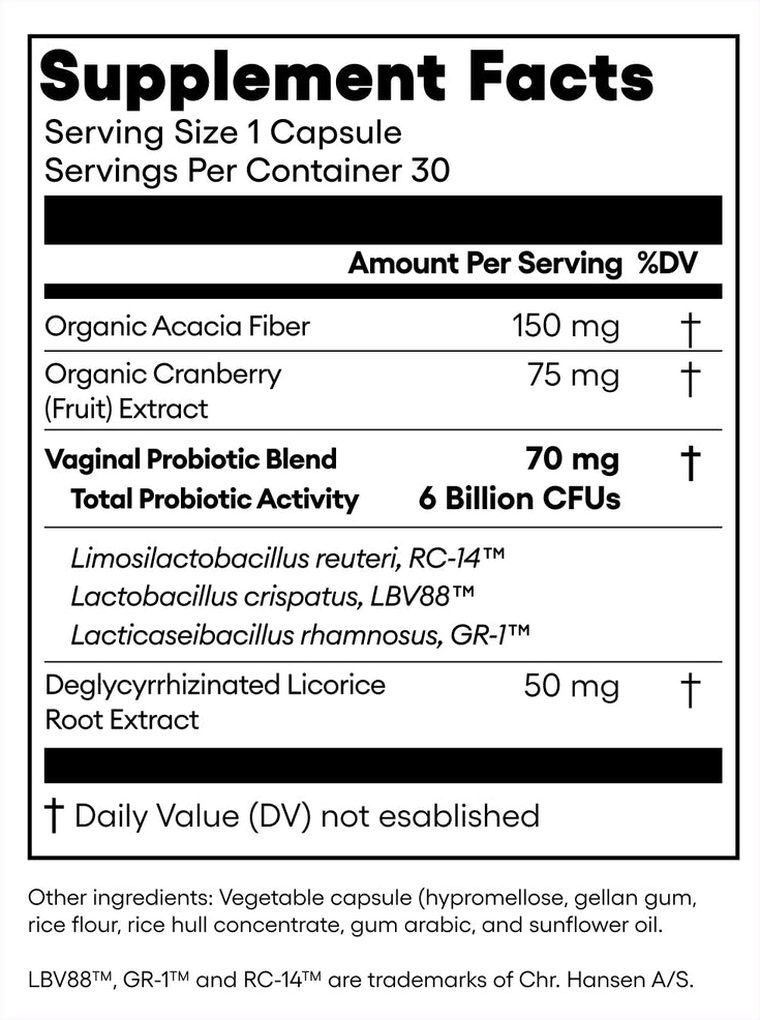
- Vaginal Probiotic: 1 capsule per serving, 30 servings, 6 billion CFU from 3 coded strains; the panel does not say when the CFU is counted. [Physician's Choice label, checked Oct 10, 2026]
What is a vaginal probiotic?
A probiotic product sold with vaginal health in mind. It may be a capsule or pill, a gummy, or a suppository capsule placed in the vagina.
The microbes answer to the same definition as any probiotic. ISAPP, the International Scientific Association for Probiotics and Prebiotics, says probiotics are live microorganisms that, when administered in adequate amounts, confer a health benefit. That sentence names no body part.
What changes from one product to the next is the form, and the form sets the route. Harvard Health Publishing describes two common kinds of vaginal probiotic supplement: probiotic pills, and "suppository capsules that are inserted into the vagina using an applicator." FDA lists gummies among the forms a dietary supplement can take, which adds a third.
Still deciding between a general women's probiotic and a vaginal one? Our answer on one women's probiotic or two covers that choice.
Capsules, gummies or suppositories: how do the three forms compare?
They differ in how you take them, where the microbes go first and what the package has to tell you.
Three forms of vaginal probiotic, side by side
| Form | How you take it | Where it goes first, per the sources | What the package should show | A question for your clinician |
|---|---|---|---|---|
| Oral capsule | Swallowed, at the serving the label gives | The digestive tract, where NIH says probiotics mainly act; onward transfer to the vagina is a lab finding so far (Cleveland Clinic) | A Supplement Facts panel: genus, species and strain, CFU and when it is counted, storage, expiration date (NIH) | Do any of the strain codes on this label fit what I want to try? |
| Gummy | Chewed and swallowed | The same route as a capsule; the one gummy trial we found measured spores in stool, nothing in the vagina | The same panel items; check the species, since gummy makers turn to spore-forming bacteria (2024 study) | Is the species in this gummy the kind you would suggest? |
| Vaginal suppository or insert | Inserted into the vagina, often with an applicator (Harvard Health Publishing) | The vagina directly; suppositories dissolve or melt once inside the body (Cleveland Clinic) | Whatever its package prints, FDA's definition of a dietary supplement covers only products that are swallowed; follow the package directions and storage line | Is it safe for me to insert this, given my medical history? |
Sources: NIH Office of Dietary Supplements; FDA; Harvard Health Publishing; Cleveland Clinic; Current Research in Food Science, 2024. Full list at the end.
Vaginal probiotic capsules: where does a swallowed probiotic go?
Into the digestive tract first. The NIH consumer fact sheet says it in one line: "Probiotics act mainly in the digestive tract."
Whether a swallowed strain then reaches the vagina is still being worked out. A Cleveland Clinic ob/gyn puts the evidence this way:
"The transfer of bacterial strain from the gut to the vagina has been indicated in a lab."
Oluwatosin Goje, MD, ob/gyn, Cleveland Clinic Health Essentials, Jun 20, 2022
Harvard Health Publishing is more cautious still, writing that "it’s not at all clear that taking a probiotic orally will help the vagina." Trials that checked whether a swallowed strain shows up in vaginal swabs are laid out in Do vaginal probiotics work? What studies measured, what they cannot do, and when to see a doctor.
A capsule does have one practical edge: it is the form most human research uses. The authors of the 2024 gummy study below note that human trials counting live probiotic microbes in stool mostly use capsules, powders or sachets.
Vaginal probiotic gummies: what changes in a gummy?
Mostly the way it is made. A gummy is cooked candy, so the microbes have to survive heat on the production line.
A 2024 study in Current Research in Food Science shows what that looks like. The researchers added probiotic spores to cooked gummy syrup once it reached about 75 to 85 °C, then gave one serving a day to 24 healthy adults for two weeks. Spores germinated in all of the volunteers, judged from their stool samples. The study measured the gut only.
Keeping probiotic cells alive through manufacturing is the hard part, the authors write, and
"To overcome this, the food industry has increasingly turned to spore-forming bacteria"
Perotti and colleagues, Current Research in Food Science, 2024
So on a gummy, read the species line first. A spore former such as Heyndrickxia coagulans, the species in that study, is a different organism from the Lactobacillus species on many capsule labels, with different research behind it.
Vaginal probiotic suppositories: how are they used, and are they supplements?
They are inserted, not swallowed, which puts them outside FDA's definition of a dietary supplement.
FDA's questions and answers page says dietary supplements "are products that are ingested" and that "they must be swallowed," so topical or inhaled products are not supplements. Its list of supplement forms runs from pills and capsules to gummies, softgels, liquids and powders. An insert is none of these.
Cleveland Clinic's suppositories page describes products placed in the rectum, vagina or urethra that "dissolve or melt once inside your body." Some need refrigeration and should come to room temperature before use, it says, and readers should follow the instructions from their provider or on the packaging.
That is why our only advice on inserting any product is short: ask your doctor or gynecologist first.
What should a vaginal probiotic label show? One capsule, read line by line
The full strain name, a CFU count with its counting date, storage instructions and an expiration date. NIH names each of them.
"On the product label, you can find information about the genus, species, and strain of the microorganisms; the expiration or use-by date; and storage instructions."
NIH Office of Dietary Supplements, Probiotics fact sheet for consumers, updated Nov 17, 2025
Then check the CFU line. NIH says some products list the count at the time of manufacture and others through the expiration or use-by date, and that the count can decline over time.
And read the species. Harvard Health Publishing notes that "L. crispatus and L. iners are the most common species found in the vagina," while most probiotics and yogurts carry species more common in the gut, such as L. rhamnosus or L. acidophilus. The first of those now carries a new genus name; the old and new names on both Physician's Choice labels are side by side in Lactobacillus probiotics for women: the species on the label and their new names.
Vaginal Probiotic, read against NIH's label list
| Label line | What to look for | Vaginal Probiotic, as printed |
|---|---|---|
| Form | A Supplement Facts panel means a product you swallow (FDA) | Supplement Facts panel; vegetable capsule (hypromellose, gellan gum, rice flour, rice hull concentrate, gum arabic, sunflower oil) |
| Genus, species and strain | A code after each species (NIH) | Limosilactobacillus reuteri RC-14™, Lactobacillus crispatus LBV88™, Lacticaseibacillus rhamnosus GR-1™ |
| CFU per serving | A count of active microbes (NIH) | 6 billion CFU, in a 70 mg blend |
| When the CFU is counted | At manufacture or through expiration (NIH) | Not stated on the panel |
| Serving | Units per serving and servings per bottle | 1 capsule; 30 servings |
| Other ingredients by weight | Each extra in mg | Organic acacia fiber 150 mg; organic cranberry (fruit) extract 75 mg; DGL licorice root extract 50 mg |
| Storage | Refrigerator or room temperature (NIH) | Not on the panel; not yet on our record |
| Free-from statements | Diet and allergy notes | Vegan, gluten-free and dairy-free, per the product page |
Source: Physician's Choice Vaginal Probiotic Supplement Facts panel and product page, checked on physicianschoice.com on Oct 10, 2026. "What to look for" follows NIH's Office of Dietary Supplements and FDA.
Where Physician's Choice fits
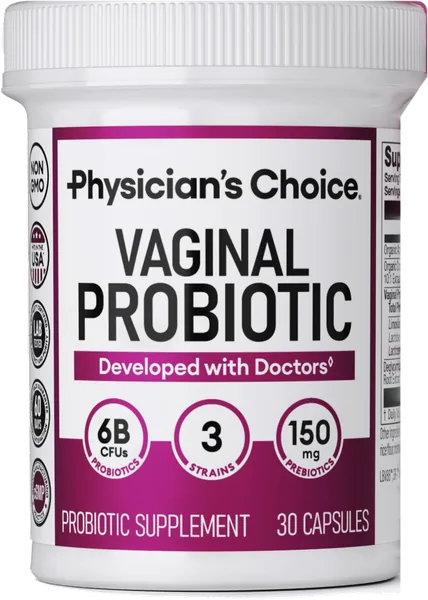
Physician's Choice publishes this site and makes Vaginal Probiotic, the capsule read above. It is a capsule you swallow, not an insert, with 6 billion CFU from three coded strains per capsule. Physician's Choice also makes Women's Probiotic, another swallowed capsule, at 50 billion CFU from 6 species with no strain codes printed.
Physician's Choice is our brand name, not a claim that doctors recommend or endorse our products. Talk with your healthcare provider before adding a new supplement or making changes to your health routine.
Both labels are on physicianschoice.com. To compare the two panels line by line, read what to check on a women's probiotic label.
See a doctor first if
you plan to put any product into the vagina, since Cleveland Clinic notes your provider could decide a suppository is not safe for you; you have itching, irritation or pain that lasts or returns; you take prescription medicine; or this line from the publisher of this site fits you: "If you are pregnant or breastfeeding, are seriously ill, or have a weakened immune system, consult your healthcare provider before taking a probiotic or any other dietary supplement."
Related answers on this site
- Do you need a pH-balanced feminine wash? What gynecologists say about washes and soapsWater, mild soap, and what to skip.
- Fiber supplements for women: how much fiber you need and what to check on the labelDaily goals by age, and fiber types on labels.
- Vaginal pH balance: the normal range, what shifts it, and where probiotics fitThe normal range in numbers, what shifts it, and two pH trials.
- Do vaginal probiotics work? What studies measured, what they cannot do, and when to see a doctorFour trials and five limits.
- Lactobacillus probiotics for women: the species on the label and their new namesOld and new genus names, two labels.
- What is a good probiotic for women? What to check on the labelEight label lines, two labels.
- Gut and vaginal health together: one women's probiotic or two?Strain codes and a decision table.
- Probiotic checklist for women over 40: strains, CFU and label checksFive checks and questions for your clinician.
Behind this answer
People search for vaginal probiotics by form. Of 1,031 public Reddit posts we read from 228 communities, 122 dealt with women's health and three asked about vaginal probiotic products. Every product line was checked against the Vaginal Probiotic label image on physicianschoice.com on Oct 10, 2026.
More questions
Can you insert an oral probiotic capsule into the vagina?
Ask your doctor or gynecologist first. A probiotic sold as a dietary supplement is made to be swallowed: FDA says supplements must be swallowed. Vaginal Probiotic carries a Supplement Facts panel with a serving of 1 capsule, so it is a capsule you swallow, not an insert.
Are vaginal probiotic gummies the same as capsules?
They travel the same way, since both are swallowed, but they are made differently. In a 2024 study, probiotic spores went into gummy syrup at about 75 to 85 degrees Celsius, and the authors say the food industry has turned to spore-forming bacteria to keep probiotics viable through manufacturing. Read the species on the label.
Do vaginal probiotics need to be refrigerated?
It depends on the product. NIH says some probiotics need the refrigerator and others can be stored at room temperature, and Cleveland Clinic says some suppositories need refrigeration and should come to room temperature before use. Follow the storage line on the package you have.
Is a vaginal probiotic suppository a dietary supplement?
Not under FDA's definition. FDA says dietary supplements are products that are ingested and must be swallowed, and that topical products are not supplements. A suppository is inserted, so read its package for what it is, how to use it and how to store it, and ask your doctor or gynecologist first.
Sources
- Probiotics: fact sheet for consumersNIH Office of Dietary Supplements, updated Nov 17, 2025. Where probiotics act; what a label shows; CFU at manufacture or through expiration; storage.
- Questions and answers on dietary supplementsUS Food and Drug Administration, content current as of Aug 27, 2026. Supplements must be swallowed; the forms they come in.
- ProbioticsInternational Scientific Association for Probiotics and Prebiotics (ISAPP). The definition of a probiotic.
- Should you use probiotics for your vagina?Harvard Health Publishing, Dec 27, 2019. Pills and suppository capsules; the open question about oral use; which species are most common in the vagina.
- Should you take probiotics for vaginal health?Cleveland Clinic Health Essentials, Jun 20, 2022. Gut to vagina transfer as a lab finding.
- SuppositoriesCleveland Clinic Health Library, last updated Dec 2, 2024. How suppositories work, storage, following package directions, medical history.
- Perotti S, et al. Human in vivo assessment of the survival and germination of Heyndrickxia coagulans SNZ1969 spores delivered via gummy candiesCurrent Research in Food Science, 2024. Gummy manufacturing temperature, spore-forming bacteria, a two-week trial in 24 healthy adults.
- Physician's Choice Vaginal Probiotic and Women's Probiotic labelsPhysician's Choice. Supplement Facts panel images and product page statements, checked Oct 10, 2026. The brand-name and pregnancy lines are Physician's Choice wording.